
New integrations added to Domotz including Freshdesk, Ubiquiti Cloud Key and Dream Machine. New integrations with firewalls Fortinet, Fortigate and WatchGuard. New features added including perimeter scans and the ability to snooze alerts.
What’s new
Freshdesk Integration
It is now possible to connect a Freshdesk (Freshworks) account into Domotz.
Freshdesk will become one of the Contact Channels available to be used in Shared Alerts. This means that Domotz creates and update Freshdesk Tickets when a specific event occurs on the networks or devices monitored through Domotz.
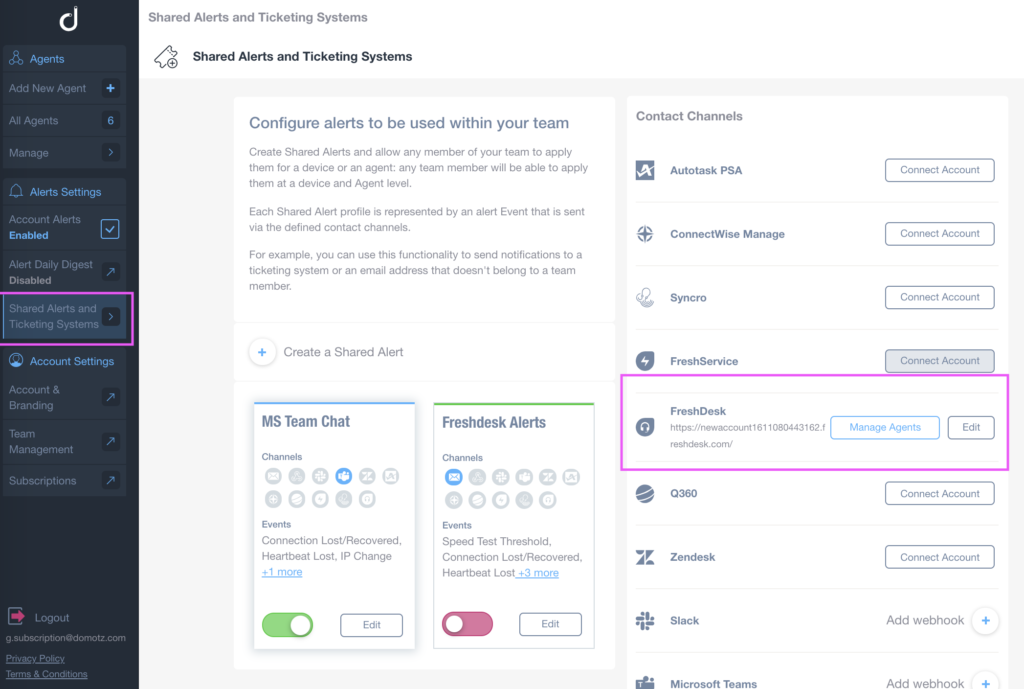
Configuring Shared Alerts and Ticketing Systems
1. Navigate to the "Shared Alerts and Ticketing Systems" section in the "Alerts Settings" menu on the left sidebar.
2. To create or manage shared alerts, click "Create a Shared Alert" below the instructions on using alerts within your team.
3. Choose between the available alert options, such as "MS Team Chat" or "Freshdesk Alerts," to set up channels and event triggers.
4. To manage agents for FreshDesk, locate it in the "Contact Channels" list on the right side. Click "Manage Agents" next to FreshDesk.
5. Use "Edit" to modify any current settings related to FreshDesk.
6. Connect other ticketing or alert systems by clicking "Connect Account" or "Add webhook" as applicable for systems like Autotask PSA, ConnectWise Manage, and others listed.
Users are also allowed to associate each Agent to one specific Freshdesk Company (or Customer), so that every time the ticket is automatically created in Freshdesk, it flows under that specific Company:
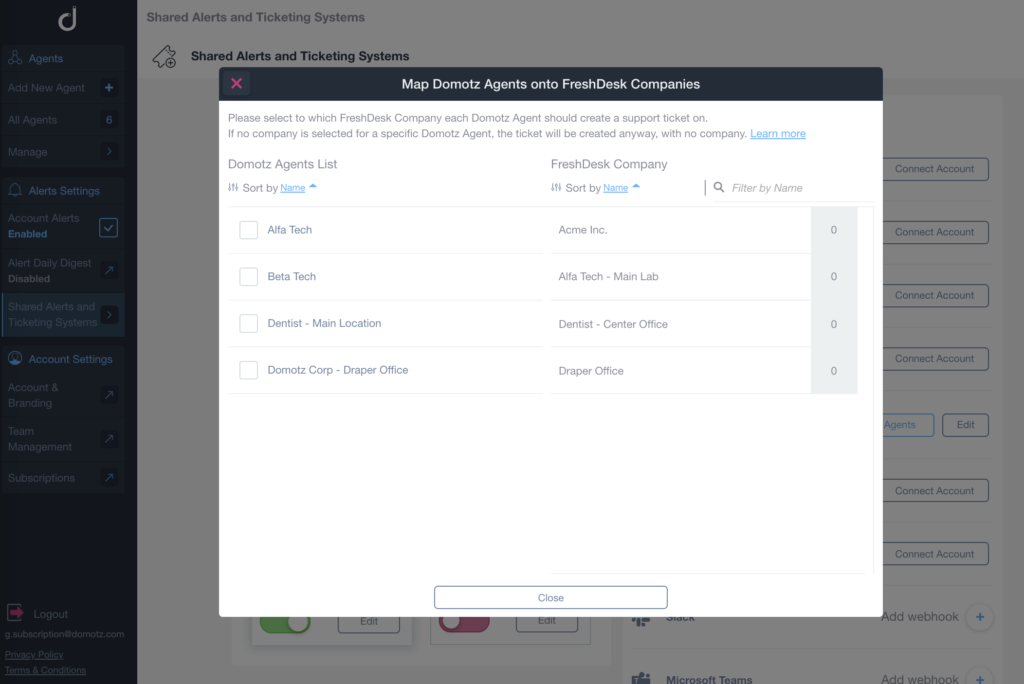
Mapping Domotz Agents to FreshDesk Companies
1. A dialog box shows a list of Domotz Agents and corresponding FreshDesk Companies. Each row displays an agent on the left and a company on the right.
2. Select a Domotz Agent by checking the box next to its name. Options include "Alfa Tech," "Beta Tech," "Dentist - Main Location," and "Domotz Corp - Draper Office."
3. Match it to a FreshDesk Company by ensuring the company name appears in the adjacent column. Available companies include "Acme Inc." and "Alfa Tech - Main Lab."
4. Use the "Sort by Name" option at the top of each column to organize the lists alphabetically.
5. Use the "Filter by Name" search bar to quickly locate a specific company or agent.
6. Finish by clicking the "Close" button to save mappings.
Domotz creates a new Freshdesk Ticket for any specified alert within Domotz. The same ticket is updated by Domotz automatically, in the case other events occur on the same network or device and as far as the ticket is still open in Freshdesk. When the previous ticket is closed and a new event occurs on the same network or device, a new ticket will be opened and a reference to the previous ticket is provided.
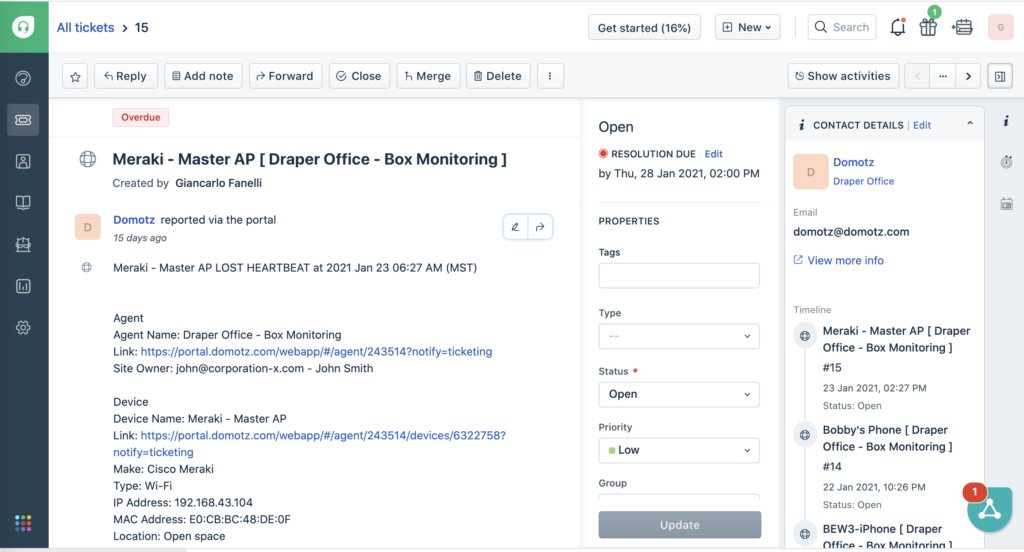
Support Ticket Dashboard Interface
1. The dashboard displays a support ticket titled "Meraki - Master AP [Draper Office - Box Monitoring]." It is marked as overdue, with a resolution due date of January 28, 2021, by 2:00 PM.
2. The ticket was created by Giancarlo Fanelli and reported via the portal by a user named Domotz 15 days ago. It concerns a lost heartbeat alert for a device named "Meraki - Master AP" at Draper Office.
3. In the Agent section, details include agent name "Draper Office - Box Monitoring," a link to the portal, and site owner John Smith's information.
4. In the Device section, details include device name, a link to the device on the portal, make "Cisco Meraki," type "Wi-Fi," and IP and MAC addresses.
5. The ticket status is set to "Open," with a priority of "Low."
6. On the right sidebar, contact details for Domotz at Draper Office are displayed, including an email link and timeline with ticket updates.
Back link to the Domotz Platforms are also provided in the Ticket so that user can jump directly on the Domotz specific Network or Device to resolve the issue.
Perimeter Scans: review latest discovered devices
Not only it is possible to configure an Alert so that you are notified as soon as a New IP based device joins your or your customers’ networks, but you can now also review the latest devices that joined it.
Navigate under the Network Security tile and you will discover a new section, reporting the number of New Devices which have been discovered on that Network in the last 24 Hours:
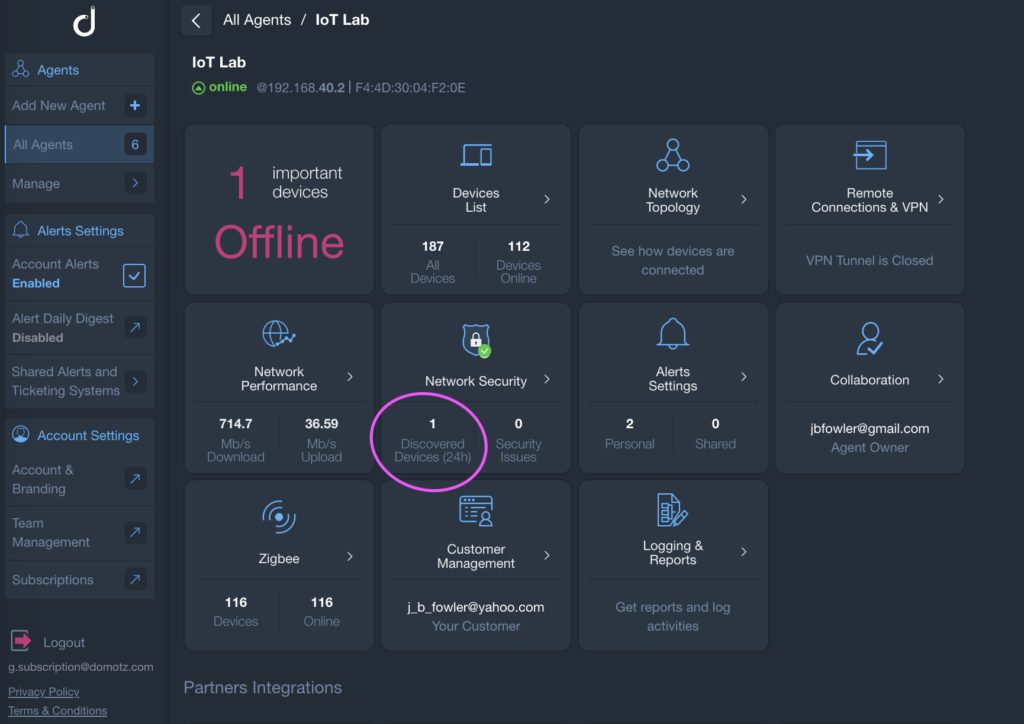
IoT Lab Dashboard Overview
1. The dashboard header indicates "IoT Lab" is online, with the IP address and MAC address displayed.
2. The "Offline" section shows one important device is offline.
3. The "Devices List" panel displays 187 total devices and 112 online devices.
4. The "Discovered Devices (24h)" panel highlights one new device discovered in the last 24 hours.
5. "Network Performance" provides download speed at 714.7 Mb/s and upload speed at 36.59 Mb/s.
6. "Network Security" panel reveals zero security issues.
7. "Alerts Settings" has two personal alerts and no shared alerts.
8. "Collaboration" section lists the agent owner’s email as jbfowler@gmail.com.
9. The "Remote Connections & VPN" indicates the VPN tunnel is closed.
10. Additional panels include "Network Topology," "Zigbee" with 116 devices online, "Customer Management," and "Logging & Reports" for activity logging.
Left sidebar options include managing agents, adjusting alert settings, and account settings.
Within the Network Security section, there will also be a summary for the New Devices discovered in the last 24 hours:
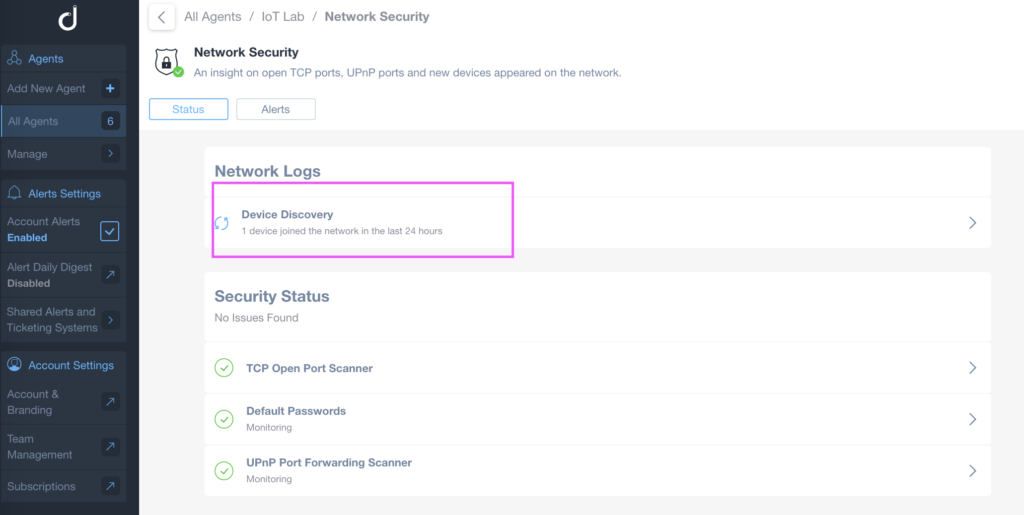
Network Security Dashboard Overview
1. Navigate to the sidebar and select "Alerts Settings" to access the management options for network alerts.
2. In the "Network Security" section, view insights on open TCP ports, UPnP ports, and newly appeared devices.
3. The "Network Logs" area displays "Device Discovery," indicating that one device joined the network in the last 24 hours.
4. Under "Security Status," see the current monitoring status:
- "TCP Open Port Scanner" with no issues found.
- "Default Passwords" monitoring is active.
- "UPnP Port Forwarding Scanner" is also under monitoring.
5. Use the tabs labeled "Status" and "Alerts" to switch between different network security views.
Clicking on the “Device Discovery” you will be listed with the history of the latest events:
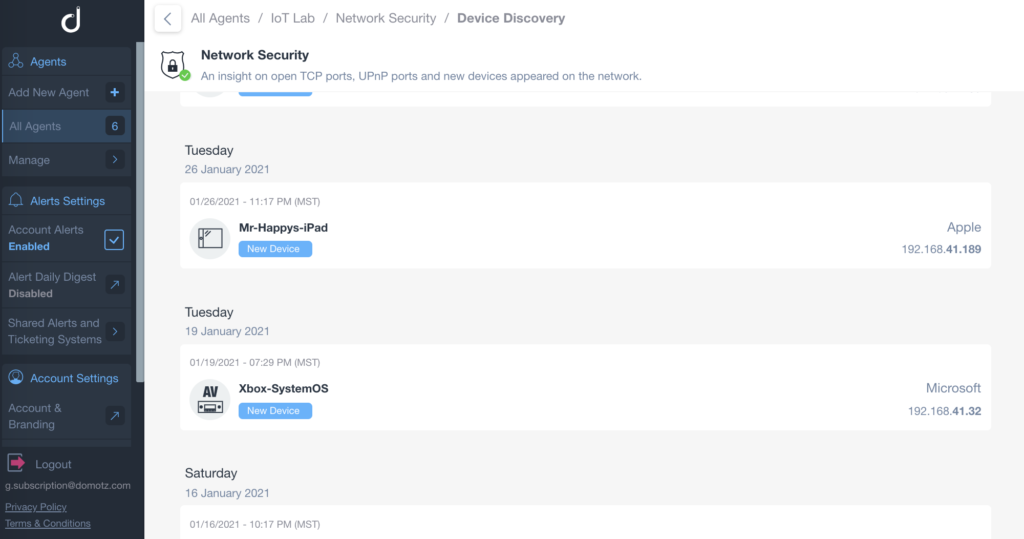
Device Discovery in Network Security Overview
1. Navigate to the "Network Security" section of the software to view device discovery details.
2. The interface displays a list of newly discovered devices with timestamps and IP addresses.
3. For example, on 26 January 2021, "Mr-Happys-iPad" was detected, classified as a "New Device," associated with Apple, and assigned IP address 192.168.41.189.
4. Another device, "Xbox-SystemOS," was recorded on 19 January 2021, with Microsoft as the manufacturer and IP address 192.168.41.32.
5. Access settings on the left sidebar to manage agents, alerts, and account settings.
6. Ensure "Account Alerts" is enabled for real-time notifications on new device discoveries.
Snooze Alerts
It is now possible to temporary disable Alerts completely on a whole Domotz Agent for:
- a specific duration
- or until a specific date/time
If you are planning to perform some maintenance activity for the next few hours on a Network, you would like to disable all the Alerts and Notifications generated by Domotz. You can now do that, without the trouble of remembering to re-enable back the Alerts.
Visit the Alerts Setting tile for the specific Domotz Agent and click on the Agent Alerts toggle:
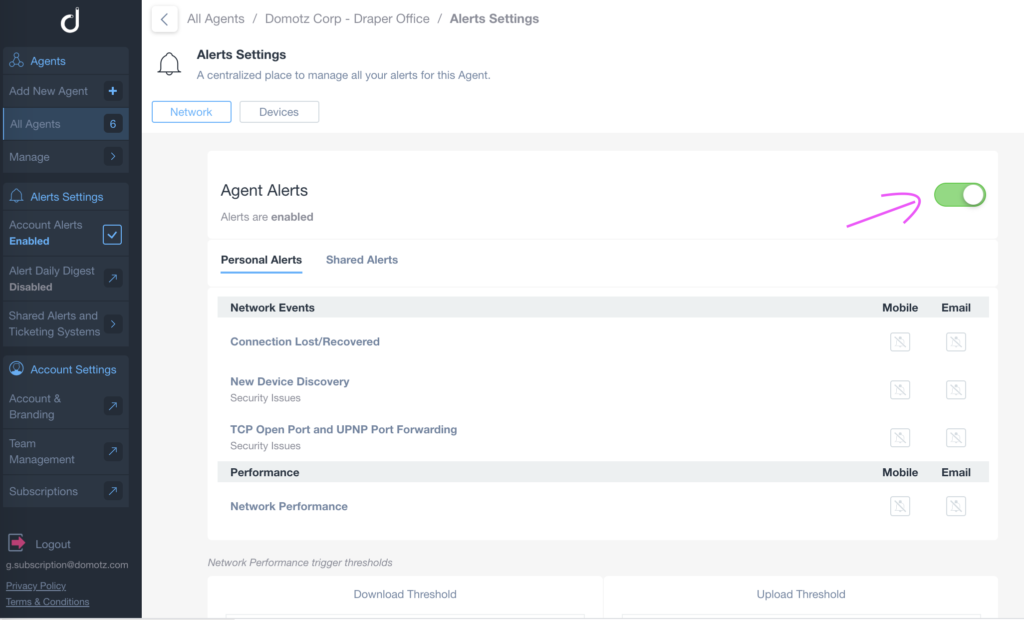
Agent Alert Settings in Software Dashboard
1. Access the Alerts Settings under the main navigation panel to manage alerts for an agent.
2. Ensure the toggle at the top right is turned on to enable alerts.
3. Choose between "Personal Alerts" and "Shared Alerts" tabs.
4. Under "Personal Alerts," view sections like Network Events and Performance.
5. Network Events includes options such as "Connection Lost/Recovered," "New Device Discovery," and "TCP Open Port and UPNP Port Forwarding."
6. Performance includes "Network Performance."
7. Configure notification preferences for Mobile and Email by toggling the respective options.
You will be proposed with the possibility to “Disable” the Alerting completely or temporary disable the alerts by “Snooze”:
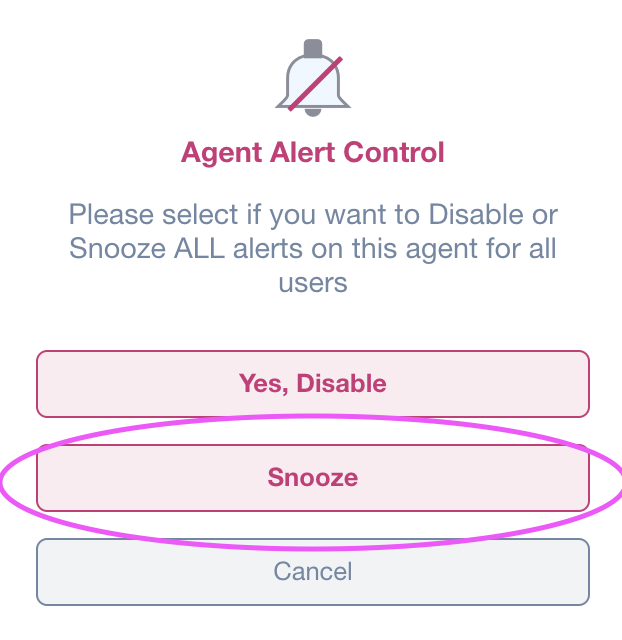
Agent Alert Control Options
1. To disable all alerts for the agent for all users, click the "Yes, Disable" button.
2. To temporarily pause all alerts for the agent, click the "Snooze" button.
3. If you do not wish to make any changes, click "Cancel" to exit.
You can then either select to temporary disable the Alerts until a specific Time and Date, of for a certain amount of time (days or hours):
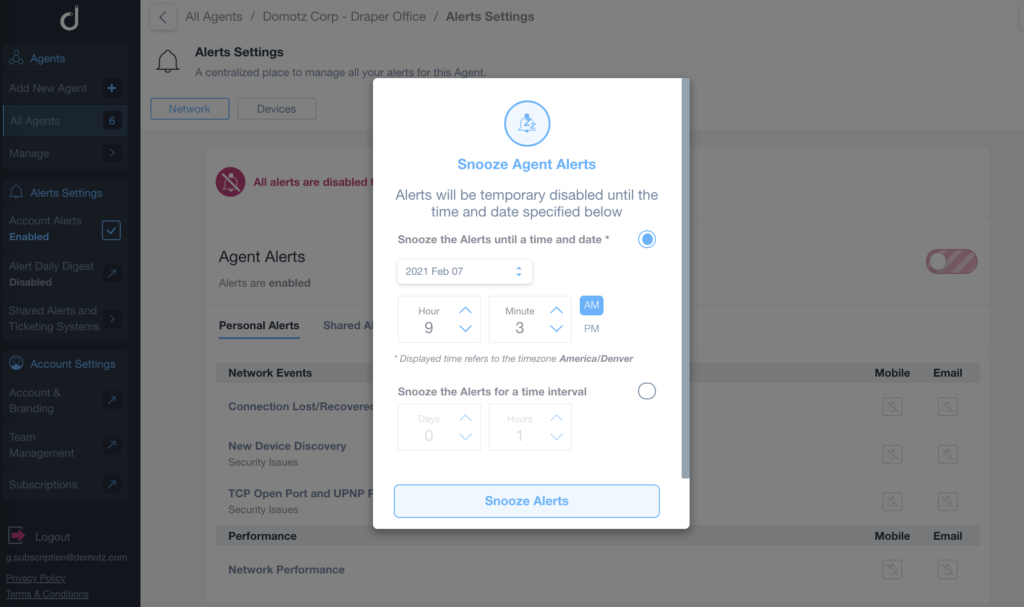
Snooze Agent Alerts Configuration
1. Open the "Snooze Agent Alerts" dialog box from the Alerts Settings page.
2. To snooze alerts until a specific date and time:
- Select the date using the date picker field.
- Choose the hour and minute, then select AM or PM.
3. Alternatively, to snooze alerts for a set time interval:
- Enter the desired number of days and hours.
4. The current timezone is displayed as America/Denver.
5. Click the "Snooze Alerts" button to apply the changes.
You can use this functionality also if you are planning not to pro-actively monitor a Network for a certain amount of days/months (e.g. in case of seasonal offices/residences).
Account Security: notification for new login
In order to improve the security around the Domotz Platform, any user will now receive an email notification if a new device is used to login into the Domotz Account:
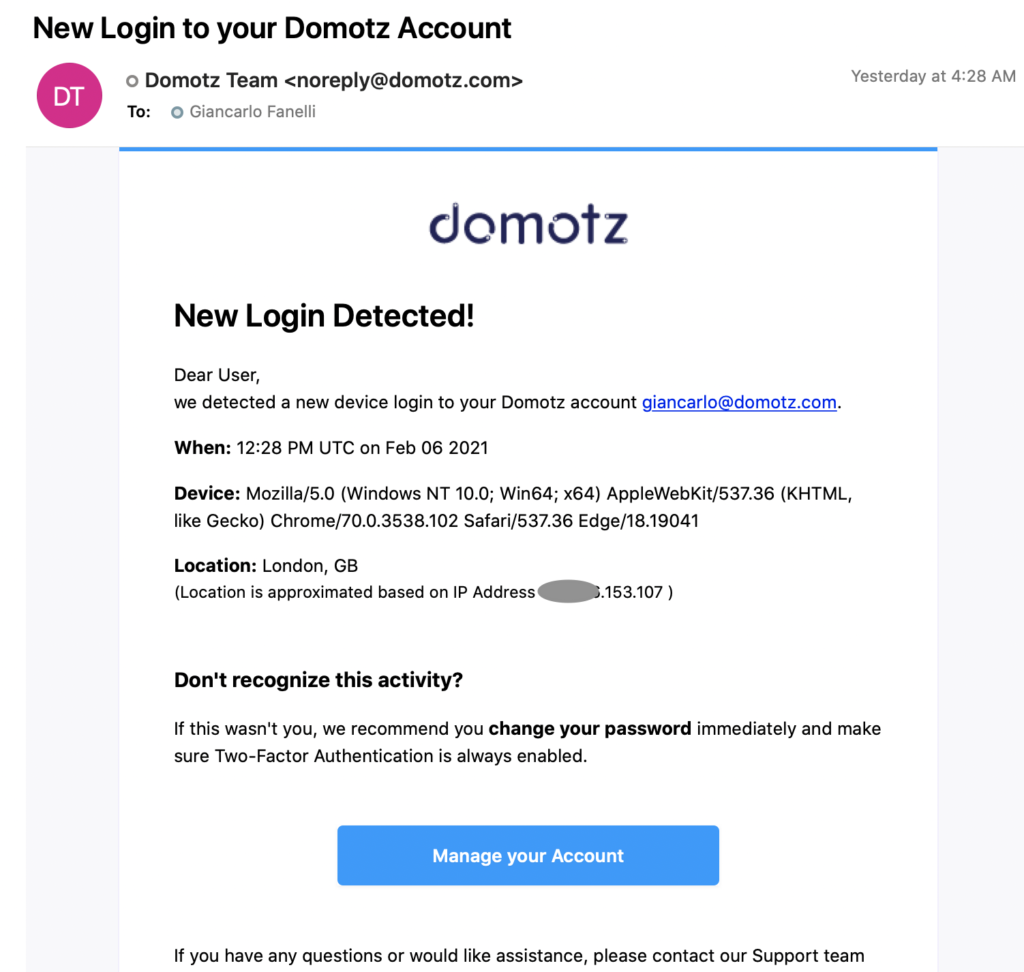
New Login Notification for Domotz Account
- The image is an email from the Domotz Team notifying the user of a new device login to their account.
- The login details include the time of access: 12:28 PM UTC on February 6, 2021.
- The device is identified as using Mozilla/5.0 on Windows NT 10.0 with specific browser versions.
- The approximate login location is London, GB, based on an IP address.
- The email suggests if the user does not recognize this activity, they should change their password immediately and ensure Two-Factor Authentication is enabled.
- A "Manage your Account" button is included for direct access to account management.
- Assistance can be sought from the Support team if needed.
Improvements
Ubiquiti UniFi Cloud Key and Dream Machine Support
It is now possible to integrate the Domotz service with the UniFi controller to enrich information for the following two Ubiquiti devices:
- UniFi Cloud Key
- UniFi Dream Machine
Configuration Management: WatchGuard and Fortigate
Always stay on top of changes happening on your network infrastructure devices.
With Domotz, you can now automatically backup the running and startup configuration files of your WatchGuard and Fortinet/Fortigate Firewalls.
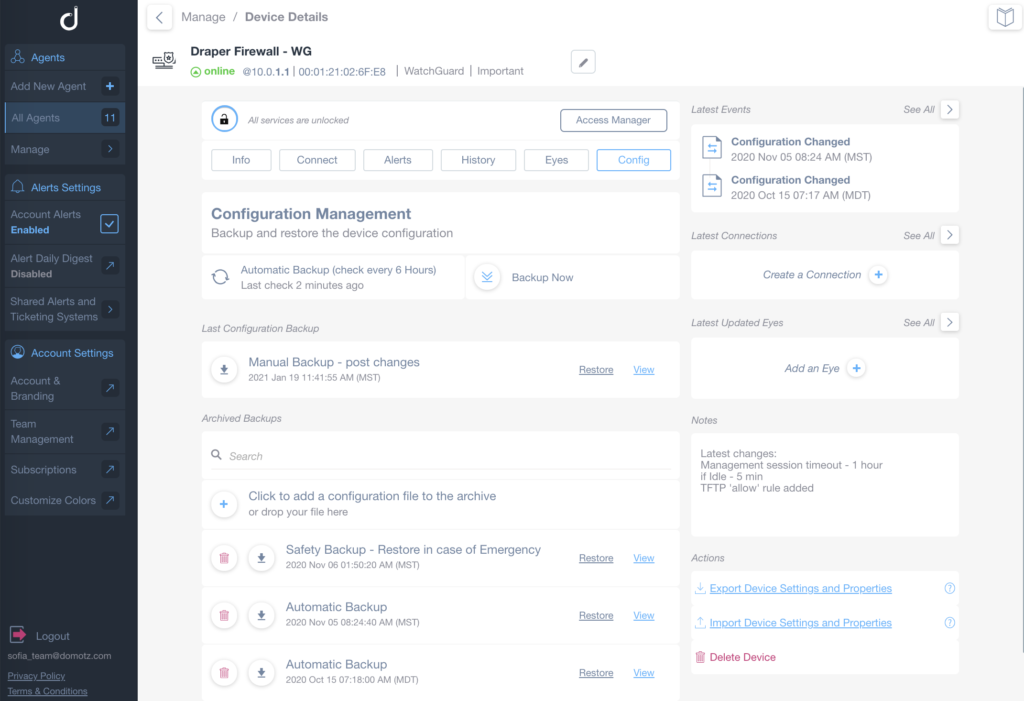
Device Details Interface for Configuration Management
1. The top section displays the device name "Draper Firewall - WG" with its online status and IP address.
2. Below, there are tabs for Info, Connect, Alerts, History, Access Manager, and Config, which provide access to various device settings and information.
3. In the "Configuration Management" section, you can perform backups. There's an option for "Automatic Backup" with a status of the last check being 2 minutes ago and a "Backup Now" button for manual initiation.
4. The "Last Configuration Backup" section shows details of the most recent manual backup, dated January 19, 2021, at 11:41:55 AM (MST).
5. The "Archived Backups" area allows you to add a new configuration file or view existing backups such as "Safety Backup" and previous "Automatic Backups," each with options to restore or view details.
6. The right sidebar includes recent events, such as "Configuration Changed" with timestamps, and options to create new connections or add monitoring features.
7. The "Notes" section outlines recent changes such as management session timeout settings.
8. At the bottom right, the "Actions" section provides links to export and import device settings and a button to delete the device.
Domotz will keep track of the configuration changes over time and notify you if any change occurs. Network or Firewall configuration issues are easily identified. Store backup files or new configuration files can be pushed to the Firewalls directly from Domotz.
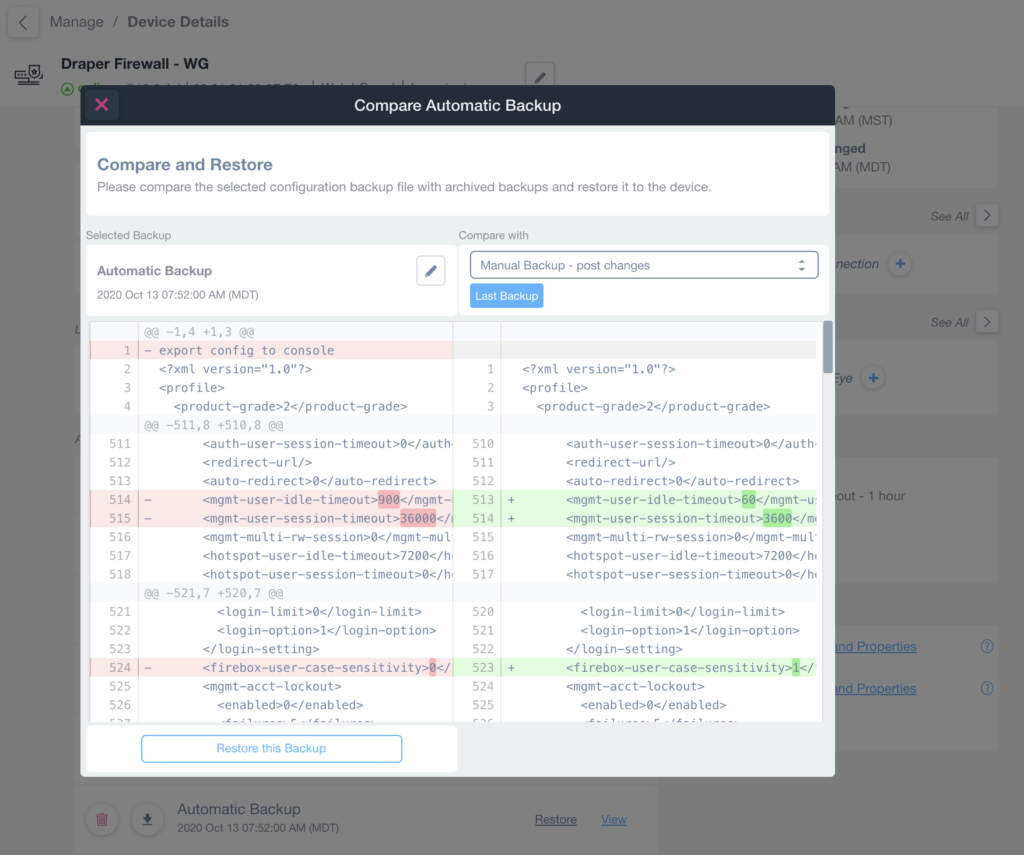
Compare and restore firewall configuration backups.
1. The window titled "Compare Automatic Backup" presents a side-by-side comparison of code from an automatic backup and an option to compare it with either a manual backup or the last backup.
2. Differences in code lines are highlighted, with deletions marked in red and additions in green.
3. Key changes include alterations to timeout settings and case sensitivity options.
4. Use the "Restore this Backup" button at the bottom to revert to the selected automatic backup if needed.
Control on Device Errors recognition
When credentials are required to unlock functionalities on specific devices, the user will be required to insert them. However, from now on, if an error is returned in unlocking the device capabilities through Domotz, the description of the error will be returned to the user.
Crestron Home Devices Support
It is now possible to monitor Cresnet devices through the new Crestron Home processors.
Stronger Passwords
When configuring new Domotz account or setting up a new password, the user will be forced to use Strong Password in accordance with the National Institute of Standards and Technology (NIST) directives.
Upon inserting a new password (or the first time during sign-up), Domotz will also check if the “hashed” version of the password is present in pawned databases (e.g. Have I Been Pwned). If so, the password is not accepted by the Domotz Portal.
SNMP via Public API
It is now possible to setup SNMP Triggers directly via Domotz Public API. For more information, please refer to the Domotz Public API documentation:
New MIBs available (SNMP)
New MIBs have been added to the list of available ones in the Domotz Cloud DB, so that adding SNMP OiD monitoring becomes easier and easier. This includes but not limited to:
- Fortigate
- Sophos XG
- Telesis Switch
- APC USP
- QSC QSY
VPN on Demand via Public API
It is now possible to create and remove VPN on Demand file using directly a Public API endpoint. For more information, please refer to the Domotz Public API documentation:
Fix
Solutions 360 / Q360: a bug on the pagination of Customers/Sites returned by Q360 has been fixed.
Apple Devices as Printers: some Apple Devices (some MacBooks) were falsely recognized as Printers.
Time Mismatch on Devices offline: a bug, affecting the timestamp of devices going offline in some peculiar cases have been fixed.
Device List Report (CSV) error: a bug, preventing the generation of CSV files for the device list under certain circumstances, has been fixed.
Security Risk on remote connections: a very rare security risk on the remote connections has been resolved. This requires an extended use of possible ports to remote connection servers.
SNMP MIBs discovery: if the discovery of one of the MIBs available to a specific device failed, this resulted in an error retrieving all the other available MIBs. The error has been fixed.
SnapAV Wattbox WB10: retrieving outlets custom name failed when names contained a comma “,”.
SpeedTest Trigger Threshold reset: the threshold set for triggering alerts on the Speed Tests results was reset to the default value when visiting the Speed Test results page. The issue has been resolved.
Users with “+” in the email address: the issue preventing users with a plus sign “+” in the email address to login into the Portal has been fixed.
WebApp Map Dashboard: the issue causing all the Agents to be displayed with a yellow dot on the map, regardless the status of the Agent, has been fixed.
Known limitations
- VPN on Demand is currently not supported on Luxul Router based Agents. As soon as Luxul team will provide Domotz with the API resources to make this available, Domotz will add this capability.
- Eyes configured for deleted devices affect the total counting of Eyes.
- Devices with multiple network interfaces (multiple MAC address) can’t be merged into single device. This affect also some type of switches which appear as multiple instances on Domotz when VLANs are configured.
- Static IP address on the Domotz Box cannot be configured before configuring the Agent.
- DHCP cannot be leveraged on additional VLANs on the Domotz Box.
- Configuration Management for Cisco IOS devices is currently not available when Domotz Agent is hosted on Windows machines.