

How to deploy a prebuilt Hyper-V VM agent
This article contains a few tips and tricks on how to deploy a pre-built Hyper-V virtual machine image to a Hyper-V host.
Get your pre-built Hyper-V image
1. Download the Hyper-V image from here:
- US Mirror: domotzpro-ubuntu-24.04.2-x64-4.9.2-7.4.2-b001-204-hyper-v_2025.zip
- EU Mirror: domotzpro-ubuntu-24.04.2-x64-4.9.2-7.4.2-b001-204-hyper-v_2025.zip
2. Unzip it in a location of your choice.
Deploy the VM
1. Open the Hyper-V Manager > Click on Action > Import Virtual Machine:
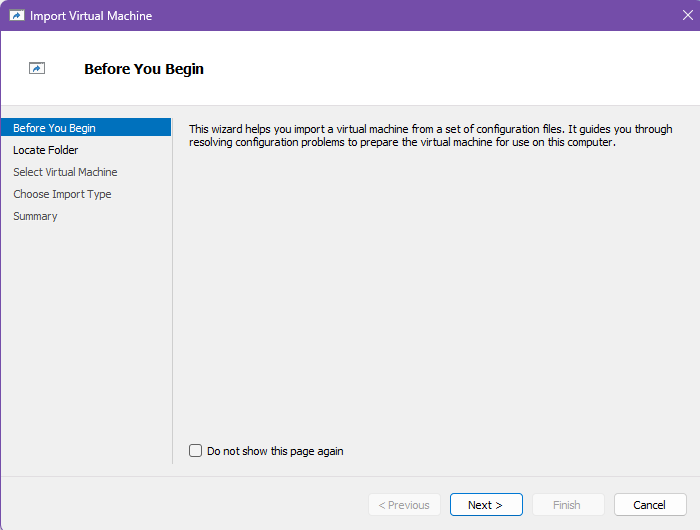
Import Virtual Machine Wizard Start Screen.
1. The screen introduces the wizard for importing a virtual machine using configuration files.
2. It explains the process will help resolve configuration problems for the virtual machine's use.
3. The left pane features a navigation menu with steps: Before You Begin, Locate Folder, Select Virtual Machine, Choose Import Type, and Summary.
4. A checkbox option allows you to skip this page in future imports.
5. Click "Next" to proceed, "Cancel" to exit, or "Finish" if available later.
2. Click on Next > Browse and choose the folder where you extracted the VM Image:
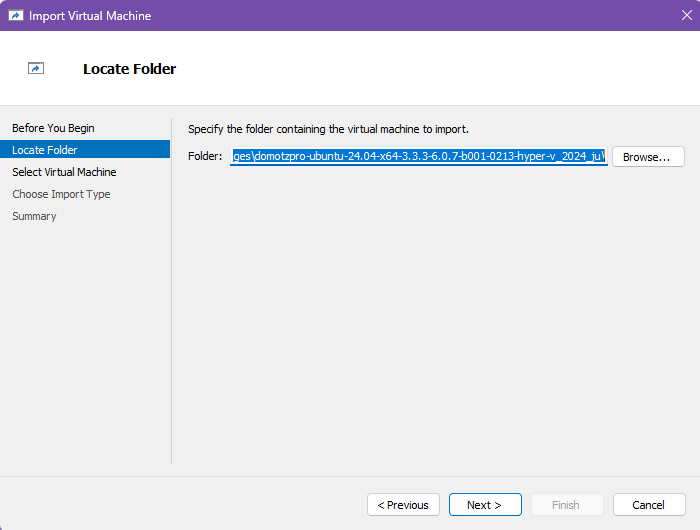
Importing a Virtual Machine - Locate Folder
1. In the "Import Virtual Machine" window, select "Locate Folder" from the side menu.
2. Enter the path of the folder containing the virtual machine to import in the "Folder" field.
3. Use the "Browse" button if you need to navigate to the folder manually.
4. Click "Next" to proceed with the import process or "Cancel" to exit.
3. Select the VM image:
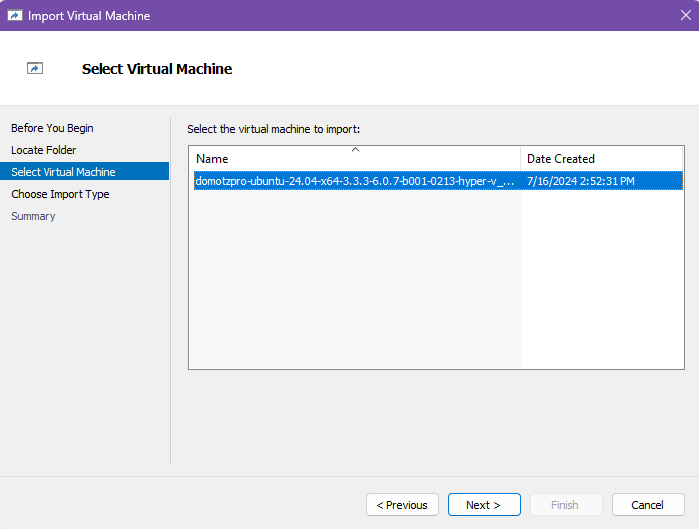
Select a Virtual Machine to Import
1. In the Import Virtual Machine dialogue, ensure "Select Virtual Machine" is highlighted in the navigation pane on the left.
2. In the central panel, review the list of available virtual machines. The columns display "Name" and "Date Created."
3. Click on the desired virtual machine entry — for example, a machine named "domotzpro-ubuntu-24.04-x64" created on "7/16/2024".
4. Select the "Next" button at the bottom to proceed with the import process, or "Cancel" to exit.
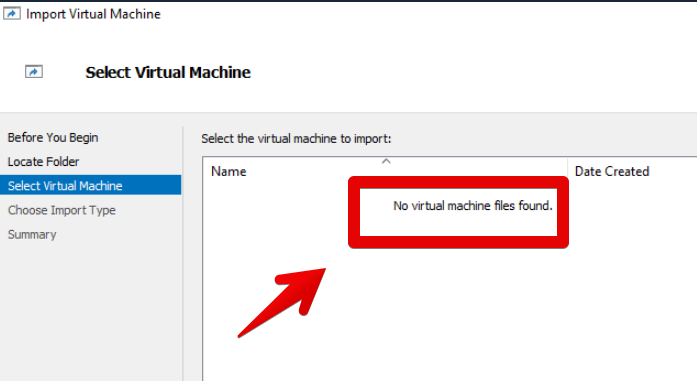
Selecting a Virtual Machine for Import
1. In the software's import section, navigate to "Select Virtual Machine."
2. Look for the message indicating no virtual machine files are available. This suggests that no files are present in the current directory.
3. Confirm if the correct directory is selected using the "Locate Folder" option.
4. If no files are found, check the selected directory or ensure the files are in the expected location before proceeding.
4. Select “Copy the virtual machine (create a new unique ID)”:
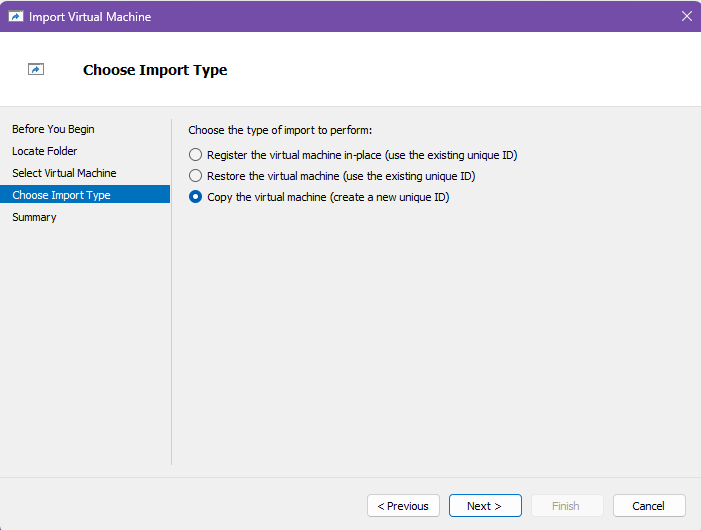
Virtual Machine Import Type Selection
1. In the "Choose Import Type" window, decide on the virtual machine import method.
2. Options include:
- Register the virtual machine in-place, using the existing unique ID.
- Restore the virtual machine, using the existing unique ID.
- Copy the virtual machine, creating a new unique ID (the recommended option is selected).
3. Navigate to the previous or next step using the "Previous" or "Next" buttons. Use "Cancel" to exit the process.
5. Select the location where you want to save the VM and the location for its virtual Disks:
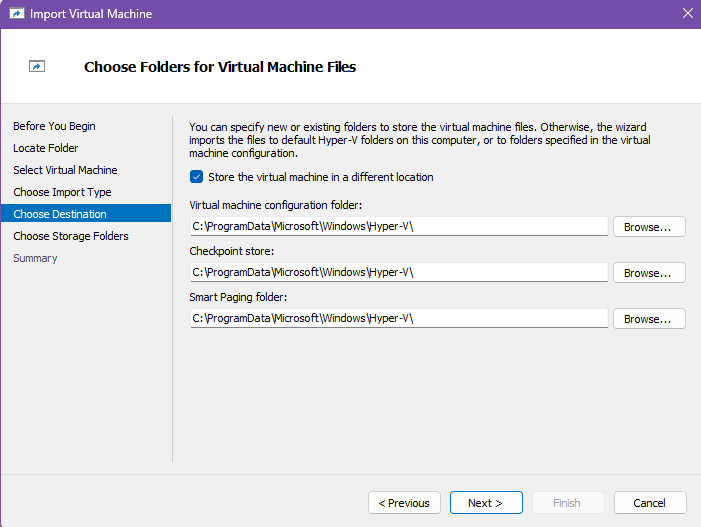
Choosing Folders for Virtual Machine Files
1. Select the option to store the virtual machine in a different location by checking the box labeled "Store the virtual machine in a different location."
2. Enter or confirm the path for the "Virtual machine configuration folder" using the provided text field, or click "Browse" to select a folder.
3. Do the same for the "Checkpoint store" and "Smart Paging folder" fields, ensuring each location is correct.
4. Click "Next" to proceed, or use "Previous" to go back and "Cancel" to exit the setup.
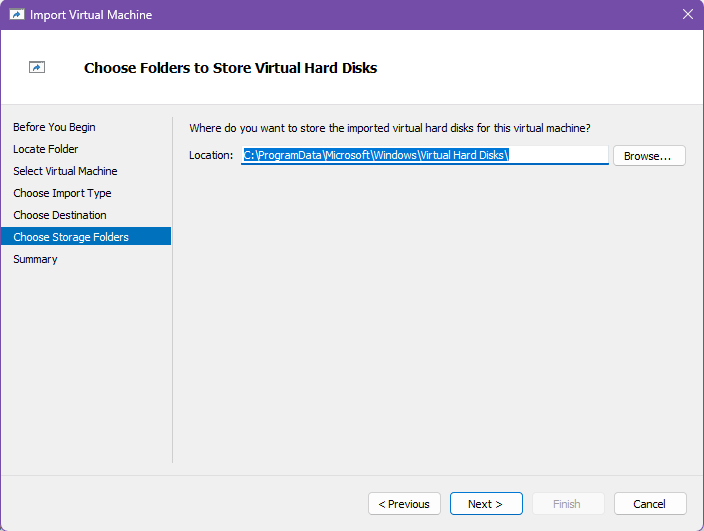
Choosing a Location to Store Virtual Hard Disks
1. In the "Import Virtual Machine" dialog, select "Choose Storage Folders" from the options on the left.
2. To specify where to store the imported virtual hard disks, look for the "Location" field.
3. The default path is set to "C:\ProgramData\Microsoft\Windows\Virtual Hard Disks."
4. If you want to change this location, click the "Browse" button and navigate to your desired directory.
5. Once the location is set, use the "Next" button to proceed or "Cancel" to exit the process.
6. Click on finish.
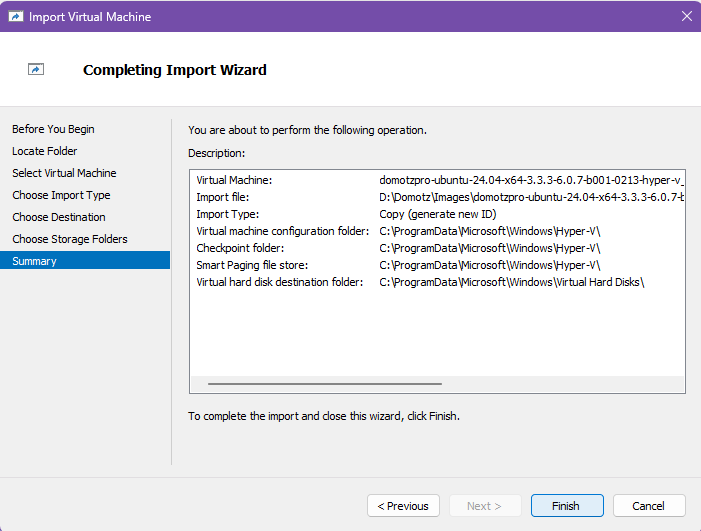
Completing Import Wizard in Virtual Machine Software
1. Review the operation details, including:
- Virtual Machine: domotzpro-ubuntu-24.04-x64-3.3.3-6.0.7-b001-0213-hyper-v
- Import file location: D:\Domotz\Images\domotzpro-ubuntu...
- Import Type: Copy (generate new ID)
- Configuration folder: C:\ProgramData\Microsoft\Windows\Hyper-V\
- Checkpoint folder: C:\ProgramData\Microsoft\Windows\Hyper-V\
- Smart Paging file store: C:\ProgramData\Microsoft\Windows\Hyper-V\
- Virtual hard disk destination folder: C:\ProgramData\Microsoft\Windows\Virtual Hard Disks\
2. Click "Finish" to complete the import and close the wizard.
7. Once the VM is imported make sure the VM is connected to the correct virtual switch configured in bridge mode. By doing this the VM will be able to get a valid IP Address on the network:
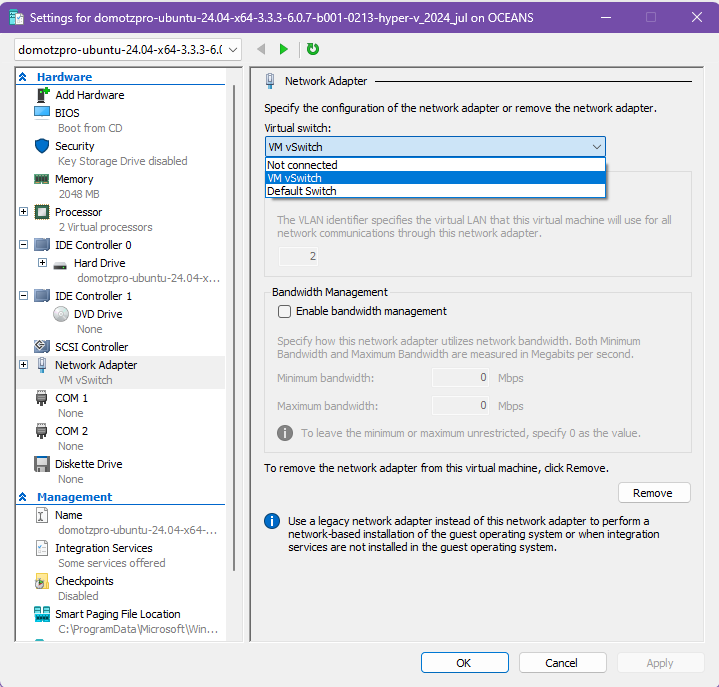
Configuring a Network Adapter in Virtual Machine Settings
1. Open the virtual machine settings window, and navigate to the "Hardware" section in the left panel.
2. Select "Network Adapter" from the list to configure or remove the network adapter.
3. In the right panel, choose the desired configuration from the "Virtual switch" dropdown menu. Options include "Not connected," "VM vSwitch," and "Default Switch."
4. To manage bandwidth, enable "Bandwidth Management" by checking the corresponding box and set minimum and maximum bandwidth values, both in Mbps.
5. To remove the network adapter from the virtual machine, click the "Remove" button.
6. If a legacy network adapter is needed for network-based installation or integration services, consider using it instead of the current adapter as recommended in the information box at the bottom.
8. Start the VM.
To login and see the current IP address use the following credentials:
User: domotz
Password: domotz
9. At the command prompt run the command “ifconfig”, the current IP Address will be shown.
10. Activate the agent from a browser to access the VM IP address (which you discovered by issuing the ifconfig command) on its port 3000.
For example, http://192.168.1.104:3000
11. Set up a process to keep the Virtual Machine always updated and upgraded to the latest releases. Only the Domotz Agent software is automatically upgraded via the SNAPd process.
Creating a Virtual Machine from Scratch using the Domotz Disk provided
Instead of importing the VM over, you will do the following:
- Unzip the Hyper-V file that you downloaded from our site (this can be unzipped wherever you wish)
- Create a new virtual machine from scratch (selecting GEN 1) (1-2 cores, 2-4 GB of RAM, 20-40 GB of HDD space)
- Select the Virtual disk that is shown.
- Start the VM
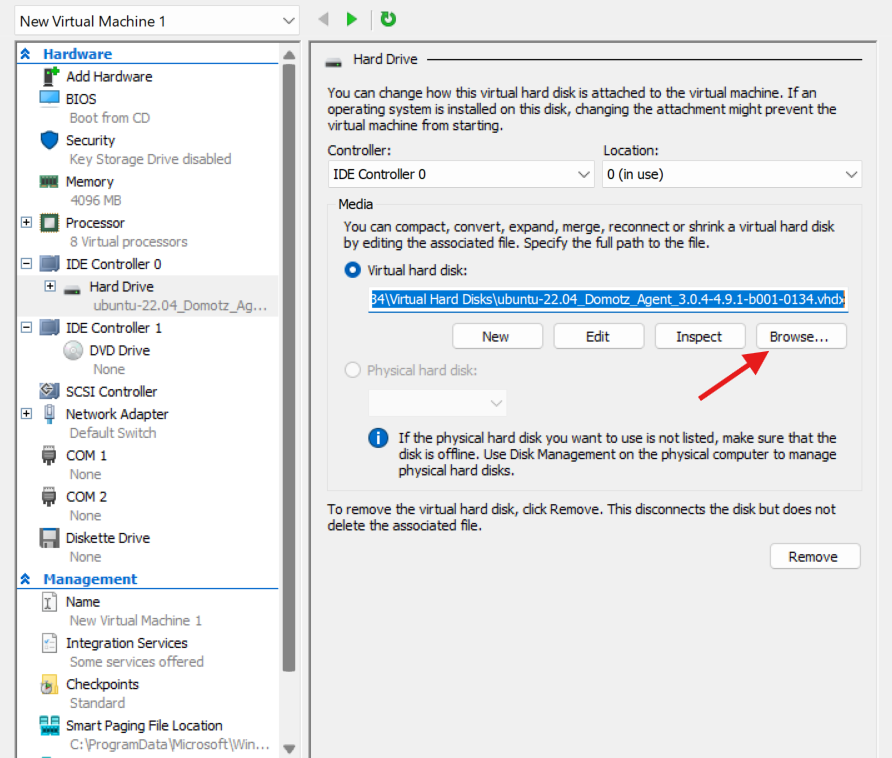
Configuring a Virtual Hard Disk in a Virtual Machine
1. In the left panel, under "Hardware," select "IDE Controller 0" and then choose "Hard Drive."
2. In the right panel, ensure "Virtual hard disk:" is selected and note the path displayed, which shows the current virtual hard disk file.
3. To change or locate a virtual hard disk file, click the "Browse..." button.
4. Ensure the correct controller and location are selected at the top of the right panel.
5. If using a physical hard disk, make sure it is online and configured through Disk Management.
6. To disconnect a virtual hard disk, click "Remove" at the bottom right.