
We’re excited to announce the newest round of updates and additions to Domotz. This month, we’re rolling out a new Domotz collector on NETGEAR routers, extended port mapping for Ubiquiti controllers, new integration scripts, improved connectivity issue resolution, and configuration management.
We highly value your feedback and encourage you to contact our support team at support@domotz.com for any comments, questions, or suggestions you may have.
New Features
Domotz collector on NETGEAR routers
We’re thrilled to announce an update to our services: the extension of our collector’s compatibility to now include NETGEAR routers and the enhancement of VLAN interface monitoring. This update broadens the array of network devices that can leverage Domotz’s robust monitoring and management capabilities, enabling you to gain greater control and insight over your network infrastructure. With the improved VLAN interface monitoring, we’re ensuring a more efficient and detailed oversight of your network’s performance and security, focusing on the critical segments that matter most.
NETGEAR Routers Compatibility: The Domotz Network Collector/Agent can seamlessly integrate with NETGEAR Router models. This expansion broadens the spectrum of network devices that benefit from Domotz’s advanced monitoring and management capabilities, offering you more flexibility and control over your network infrastructure.
VLAN Interface Scanning: Domotz has introduced the option to scan VLAN interfaces by default on NETGEAR Routers to enhance network monitoring efficiency further. This targeted approach ensures critical network segments are monitored more effectively, providing you with detailed insights into your network’s performance and security posture.
Enhanced Ubiquiti Controller Support
We have enhanced the support for Ubiquiti controllers within the Domotz platform.
This update introduces an extension of IP-based port mapping for Ubiquiti devices, significantly improving network topology visualization and management. With this advanced functionality, Domotz now adeptly maps Ubiquiti devices even when the MAC address is unavailable, such as when devices are visible on routed networks (Layer 3) but not on Layer 2.
This development ensures more accurate network topology representations and gives deeper insights into IT infrastructures, especially in complex network environments.
New Integration Scripts
VMware vCenter Monitoring
Take advantage of our new pre-configured integration scripts:
- VM Info
- VM List
- VM Disks
- VM Network Adapters
- VCenter Host List
- VCenter General Info
- VCenter System Health
- VCenter Datastore
- VCenter Services Health
These scripts have been validated and tested on VMware vCenter 7.0.3 and use HTTPS protocol. Find them in our library or customize them to fit your needs.
VM Info
Use this script to monitor the following VM info running on VMware vCenter.
You’ll be able to retrieve information about these variables:
- Name
- Instance UUID
- Operating System
- Memory
- Processors
- Cores per socket
- Version
- Power state
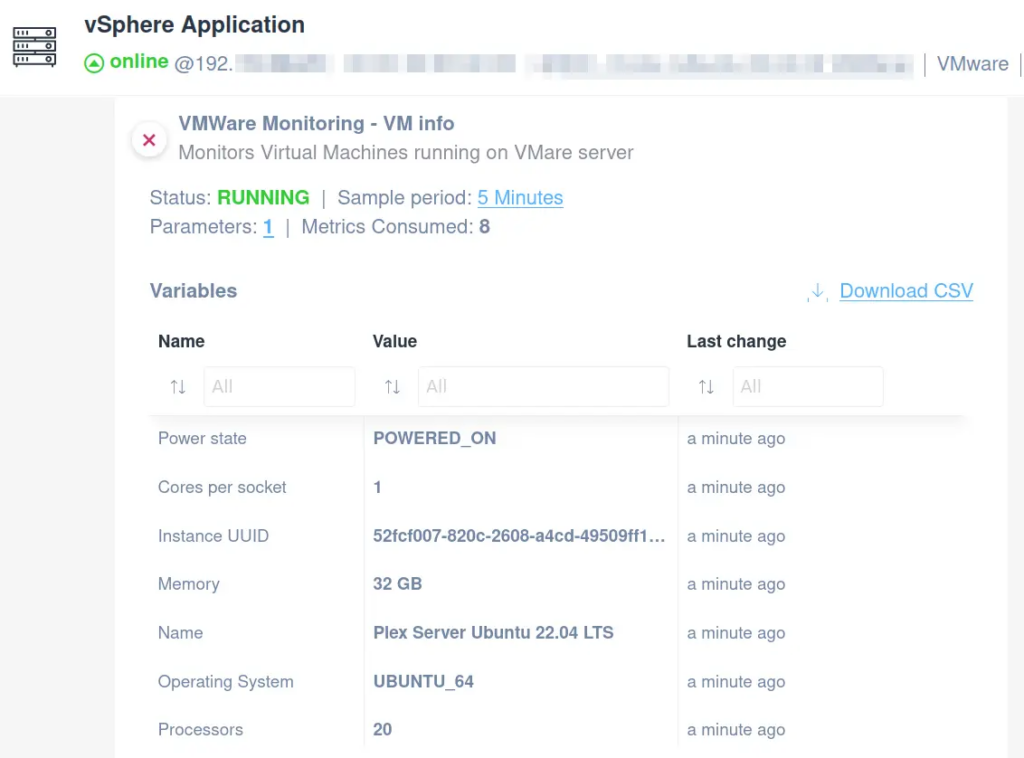
VMware Monitoring Status and Variables
1. The vSphere Application is shown as online, connected to a specific IP address.
2. The VMware Monitoring panel indicates the virtual machine's status as "RUNNING," with a sample period of 5 minutes, 1 parameter, and 8 metrics consumed.
3. A list of variables includes:
- Power state: POWERED_ON
- Cores per socket: 1
- Instance UUID: 52fcf007-820c-2608-a4cd-49509ff14f12
- Memory: 32 GB
- Name: Plex Server Ubuntu 22.04 LTS
- Operating System: UBUNTU_64
- Processors: 20
4. Each variable shows the time of the last change as "a minute ago."
5. An option to download the data as a CSV file is available.
VM List
Easily apply the script in order to monitor the VMs running on VMWare vCenter and the following:
- VM ID
- Name
- Memory
- CPU count
- Power state
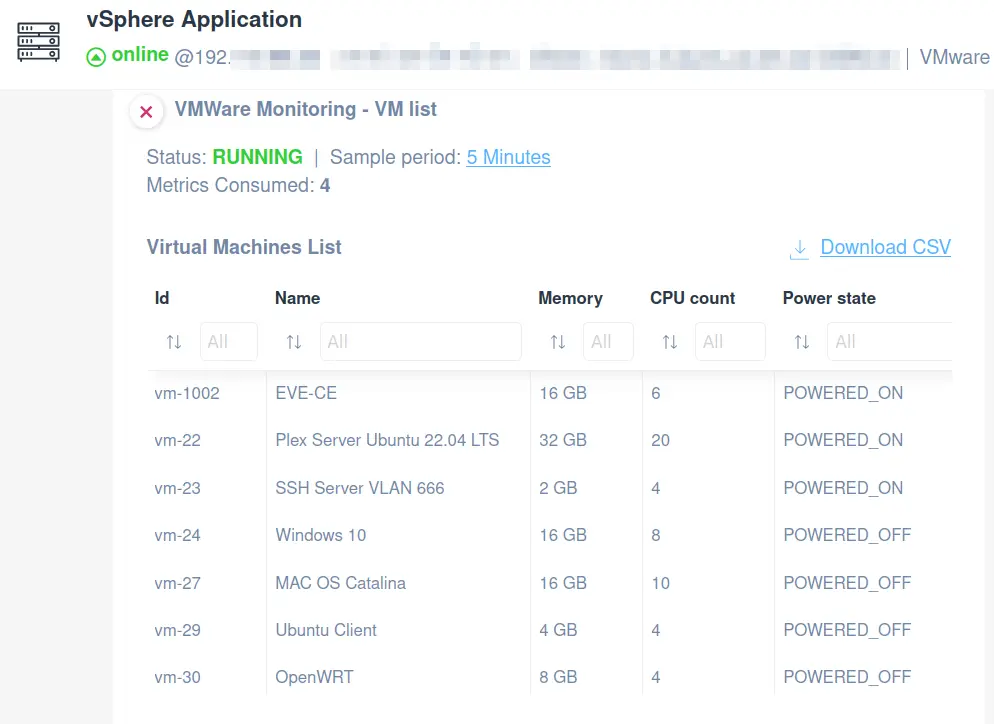
VMware Monitoring Dashboard Overview
1. The dashboard shows a list of virtual machines under "VMware Monitoring - VM list."
2. The status is indicated as "RUNNING," with a sample period of 5 minutes and 4 metrics consumed.
3. The "Virtual Machines List" includes columns: Id, Name, Memory, CPU count, and Power state.
4. Virtual machines listed are:
- vm-1002, EVE-CE, 16 GB memory, 6 CPU count, POWERED_ON
- vm-22, Plex Server Ubuntu 22.04 LTS, 32 GB memory, 20 CPU count, POWERED_ON
- vm-23, SSH Server VLAN 666, 2 GB memory, 4 CPU count, POWERED_ON
- vm-24, Windows 10, 16 GB memory, 8 CPU count, POWERED_OFF
- vm-27, MAC OS Catalina, 16 GB memory, 10 CPU count, POWERED_OFF
- vm-29, Ubuntu Client, 4 GB memory, 4 CPU count, POWERED_OFF
- vm-30, OpenWRT, 8 GB memory, 4 CPU count, POWERED_OFF
5. The option to "Download CSV" is available for exporting the list.
VM Disks
Use our dedicated script to monitor the disks connected to each VM running on VMware vCenter and the following:
- Disk ID
- Type
- Capacity
- VMDK file
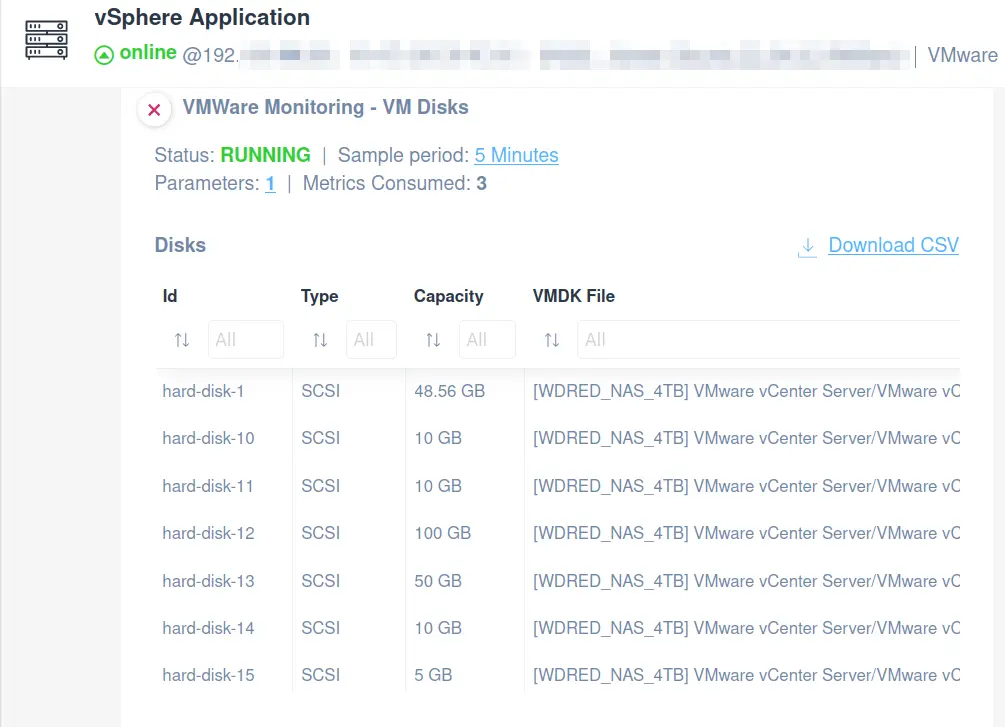
VMWare Monitoring - VM Disks Overview
1. Status: Indicates "RUNNING" in green, showing the application is active. It notes a sample period of 5 minutes.
2. Parameters and Metrics: There is 1 parameter and 3 metrics consumed.
3. Disks Table: Lists virtual machine disks with columns for Id, Type, Capacity, and VMDK File.
- Disk entries include hard-disk-1 to hard-disk-15, all with SCSI type.
- Capacities range from 5 GB to 100 GB.
- VMDK File details include a path labeled [WDRED_NAS_4TB] and its association with VMware vCenter Server.
4. Download Option: A "Download CSV" link is available for exporting disk information.
VM Network Adapters
This script allows you to monitor several key aspects of network adapters, including:
- Network adapter ID
- Network
- Network name
- MAC address
- State
By implementing this script, you can ensure comprehensive monitoring of your VMs’ network adapters, aiding in network management and troubleshooting within your VMware vCenter environment.
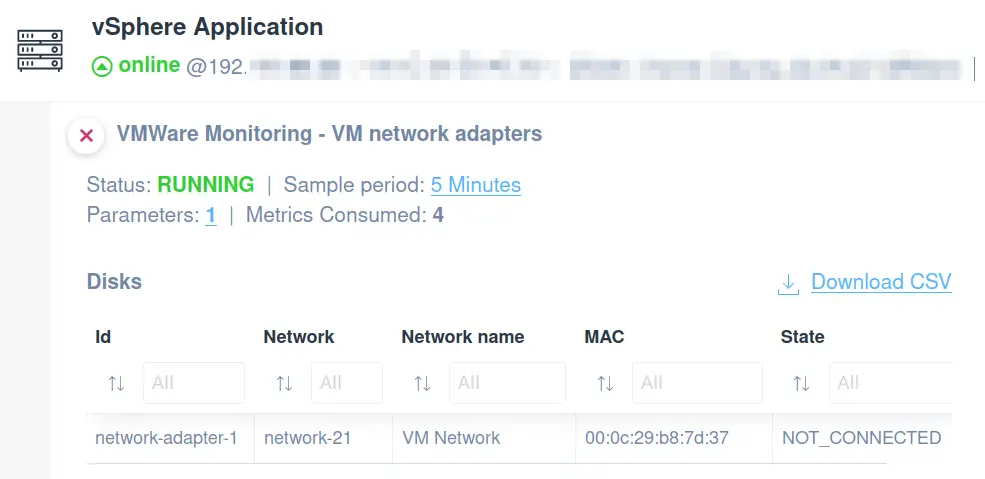
VMWare Network Adapters Monitoring Overview
1. The page title indicates a vSphere Application is online, displaying its status as "online" alongside an IP address.
2. The section titled "VMWare Monitoring - VM network adapters" shows the status "RUNNING," with a sample period of "5 Minutes." Parameters and metrics consumed are indicated as "1" and "4," respectively.
3. "Disks" section lists details of network adapters, including columns for "Id," "Network," "Network name," "MAC," and "State."
4. Under these columns, "network-adapter-1" is shown with "network-21," "VM Network," MAC address "00:0c:29:b8:7d:37," and state "NOT_CONNECTED."
5. An option to download the data is available through a "Download CSV" link.
vCenter Host List
You can monitor the hosts managed by VMWare vCenter and the following metrics:
- Host ID
- Name
- Connection state
- Power state
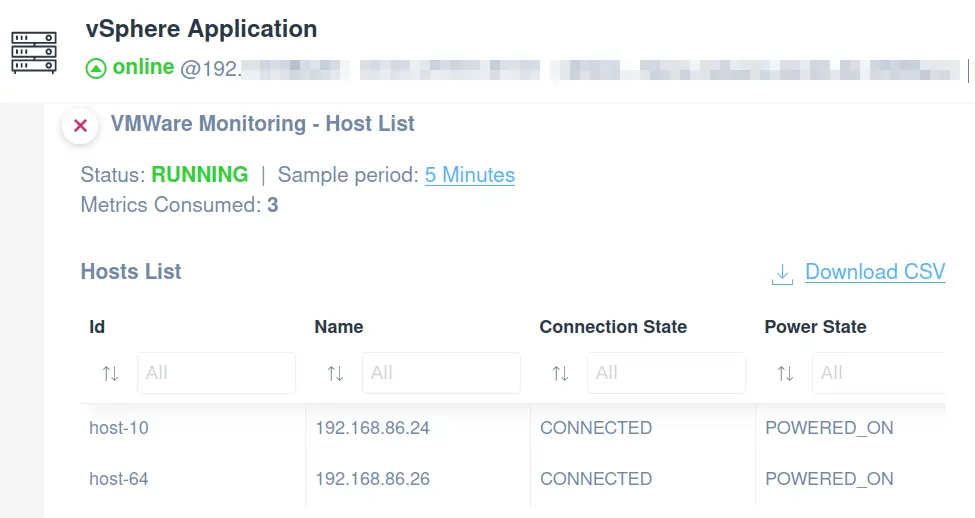
vSphere Application Monitoring Overview
1. The vSphere Application status is shown as online, indicated by a green dot.
2. VMware Monitoring - Host List displays monitoring details.
3. The monitoring Status is RUNNING.
4. The Sample Period is set to 5 Minutes.
5. Metrics Consumed is noted as 3.
6. The Hosts List table includes columns for Id, Name, Connection State, and Power State.
7. Hosts listed:
- Host-10 with IP 192.168.86.24, Connection State is CONNECTED, Power State is POWERED_ON.
- Host-64 with IP 192.168.86.26, Connection State is CONNECTED, Power State is POWERED_ON.
8. There is an option to download the host list data as a CSV file.
vCenter General Info
Applying our ready-to-use integration script, you will be able to monitor VMWare vCenter and the following:
- Product name
- Product type
- Version
- Build number
- Release date
- Install time
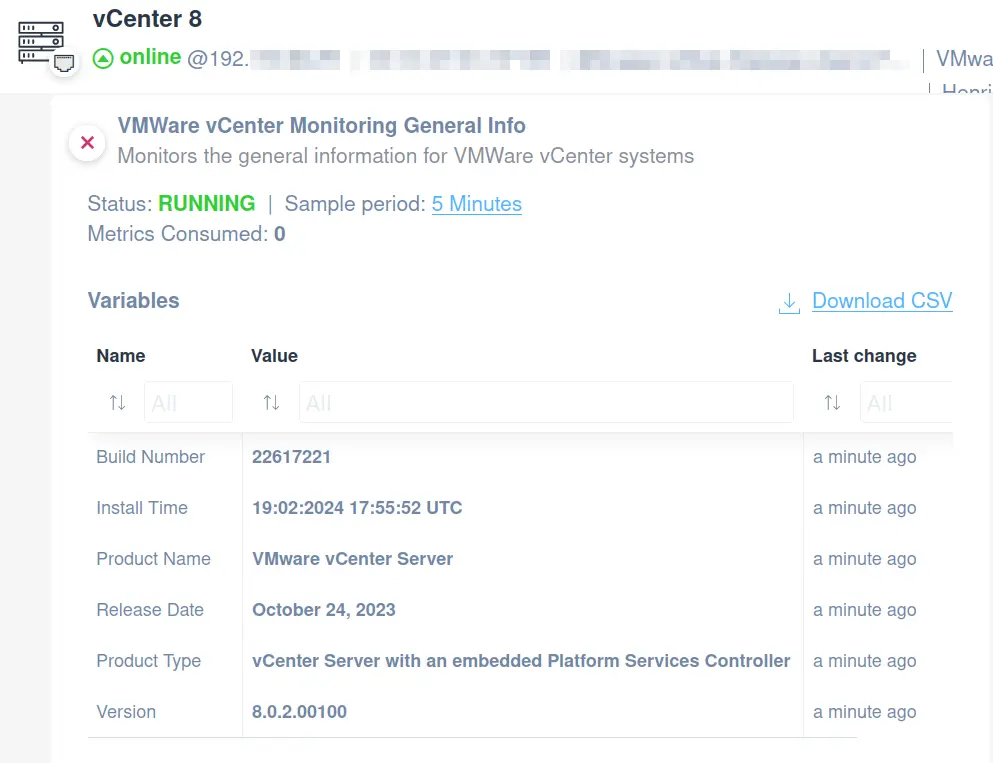
VMware vCenter Monitoring Overview
1. The vCenter 8 status is displayed as "online" with an accompanying green icon, showing the system is active.
2. Monitoring details include the current status as "RUNNING," with a sample period set to "5 Minutes" and "Metrics Consumed" at 0.
3. Under the "Variables" section, key information includes:
- Build Number: 22617221
- Install Time: 19:02:2024 17:55:52 UTC
- Product Name: VMware vCenter Server
- Release Date: October 24, 2023
- Product Type: vCenter Server with an embedded Platform Services Controller
- Version: 8.0.2.00100
4. A "Download CSV" option is available for exporting the data.
5. The "Last change" column indicates that all the data entries were updated "a minute ago."
vCenter System Health
This script enables you to gather a detailed view of the health status of your VMware vCenter.
The following can be monitored:
- System Health
- Load
- Memory health
- Appliance Management Service Health
- Storage health
- Swap health
- Database storage health
- Software updates availability
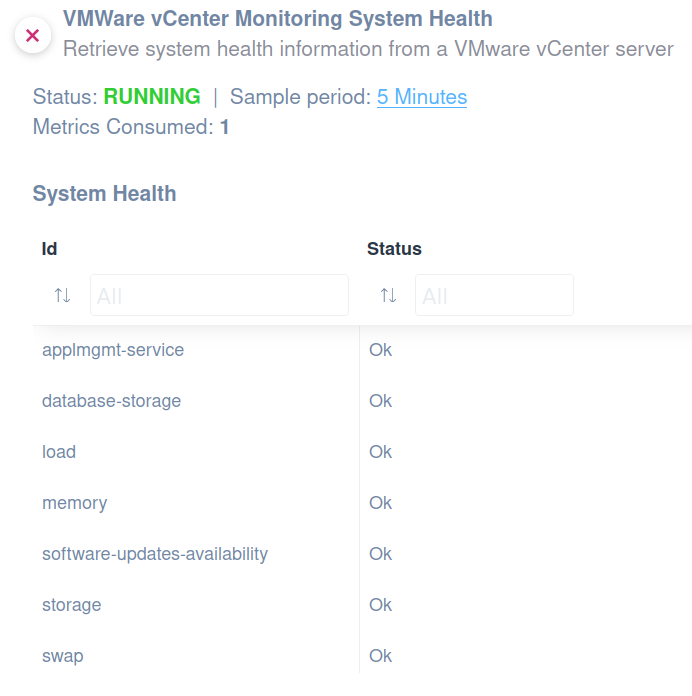
VMware vCenter Monitoring System Health Summary
1. The system status is labeled as "RUNNING" in green, indicating that it is currently operational.
2. The sample period for monitoring is set to "5 Minutes," suggesting data collection at five-minute intervals.
3. The "Metrics Consumed" is listed as "1," showing the number of metrics used.
4. Under "System Health," a table displays various components and their status.
5. Components listed include apimgmt-service, database-storage, load, memory, software-updates-availability, storage, and swap. Each component is marked as "Ok," indicating they are functioning correctly.
vCenter Services Health
By applying this script, you will immediately have more details and monitor the following:
- Service name
- Startup Type
- State
- Status
You can access this script from our library.
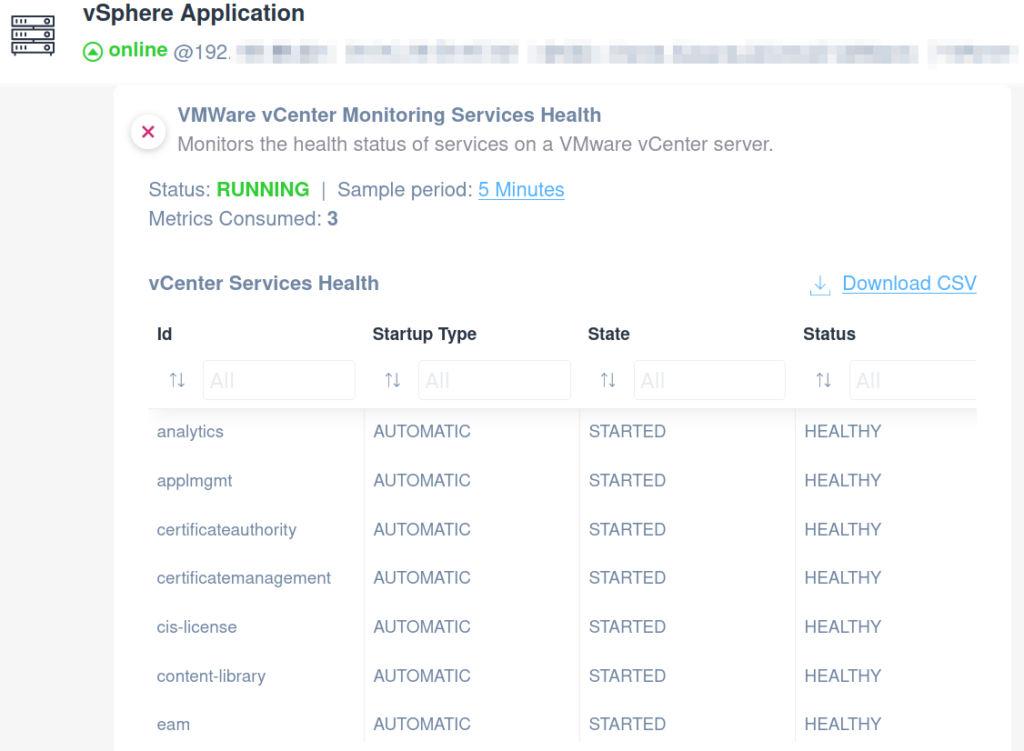
VMware vCenter Monitoring Services Health Overview
1. The dashboard displays the health status of services on a VMware vCenter server.
2. The current status is marked as "RUNNING," with a sample period of 5 minutes and metrics consumed totaling 3.
3. Below, the "vCenter Services Health" table lists service details, including:
- **Id**: The service identifiers such as analytics, applmgmt, and certificateauthority.
- **Startup Type**: All services are set to "AUTOMATIC."
- **State**: All services show as "STARTED."
- **Status**: All services are marked "HEALTHY."
4. A "Download CSV" option is available for exporting the data.
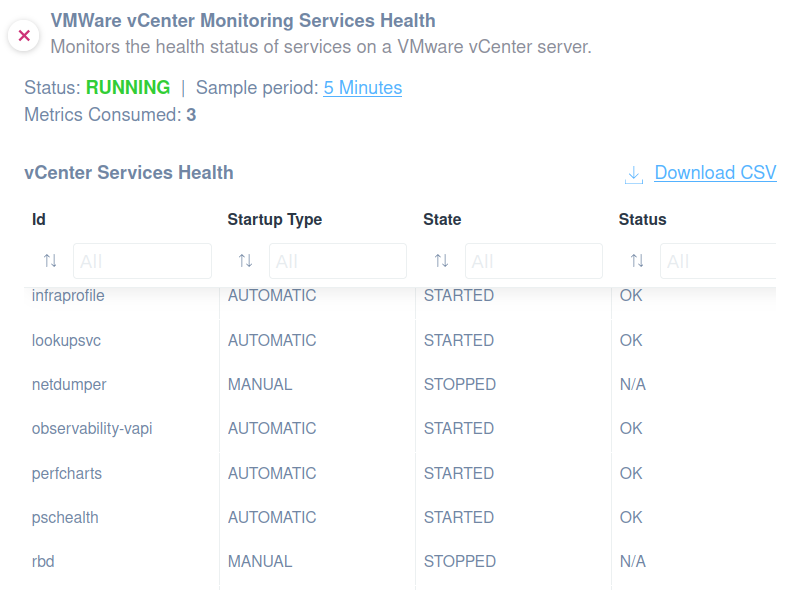
VMware vCenter Monitoring Services Health Overview
1. The status of the vCenter Monitoring Services is "RUNNING."
2. Sample period is every 5 minutes, and 3 metrics are consumed.
3. The table lists service details with columns: Id, Startup Type, State, and Status.
4. Services listed include "infraprofile," "lookupsvc," "netdumper," etc., each with startup types such as "AUTOMATIC" or "MANUAL."
5. Service states are marked as "STARTED" or "STOPPED," with corresponding status as "OK" or "N/A."
6. There is an option to download the table data as a CSV file.
vCenter Datastore
By implementing this script, you will be able to monitor free space in your VMware vCenter Datastores. The following can be monitored:
- Datastore ID
- Name
- Type
- Capacity
- Free space
- % usage
Please note that this script has been validated and tested on VMware vCenter 8.0.2.
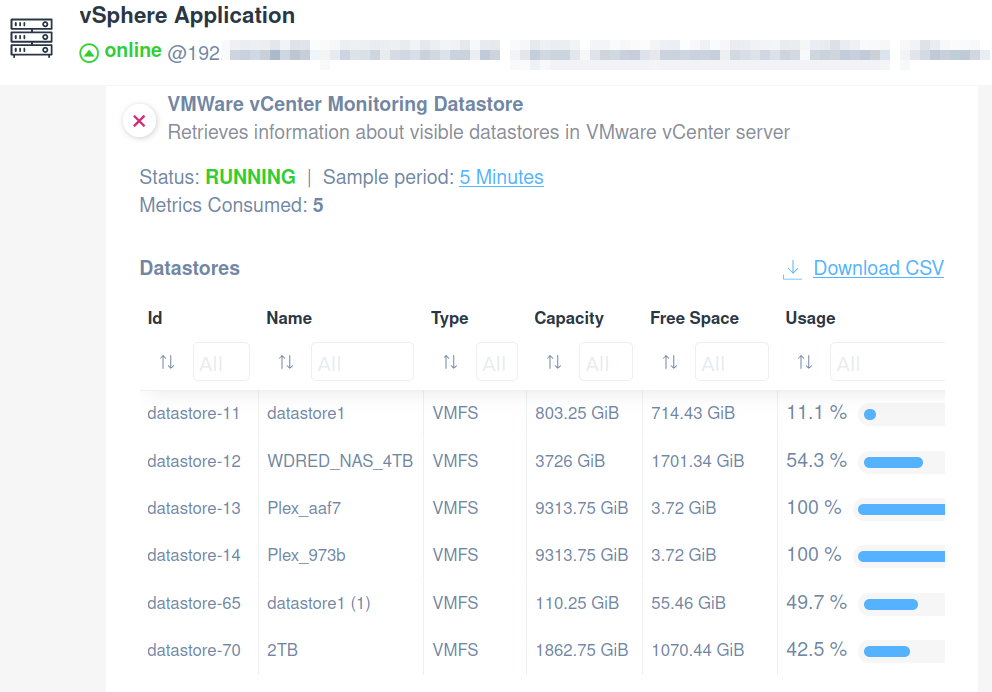
Monitoring Datastores in VMware vCenter
1. The vSphere Application is running, indicated by a green "online" status.
2. The "VMWare vCenter Monitoring Datastore" section shows that the system retrieves datastore information, with the current status as "RUNNING."
3. The sample period is set to 5 minutes, and 5 metrics are consumed.
4. The "Datastores" table displays details such as Id, Name, Type, Capacity, Free Space, and Usage for each datastore.
5. Use the "Download CSV" option to export the datastore data as a CSV file.
6. The table provides sortable columns for easy navigation and filtering with fields provided to filter by Id, Name, Type, Capacity, Free Space, or Usage.
HPE MSA SAN
Domotz network monitoring software allows you to monitor HPE MSA Storage Area Network (SAN), a flash-ready system designed for affordable application acceleration and is ideal for remote office deployments.
Monitor your HPE MSA SAN hardware using our custom scripts:
- System General Information
- Overall unit status
- HW Sensors – Temperature
- HW Sensors – Charge
- HW Sensors – Voltage/Current
- Fans
- Controllers
- Disks
These scripts use the HTTP protocol and have been validated and tested on HPE MSA 2050 SAN version VL270P005.
System General Information
Consider leveraging our System General Info custom script to keep tabs on the key aspects of your HPE MSA SAN. Key metrics you can monitor include:
- Product ID
- Midplane serial number
- Health
- Health reason
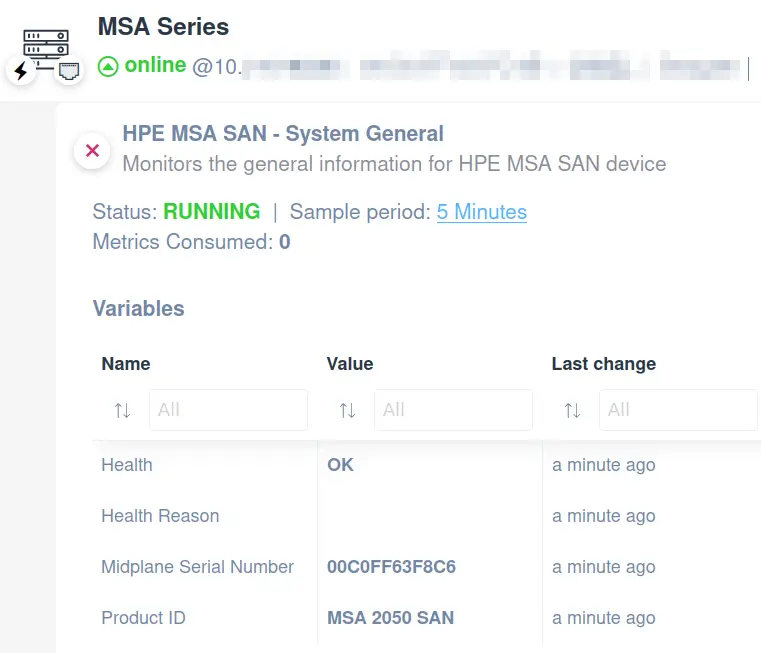
Monitoring HPE MSA SAN Device Status
1. Check the top section for the MSA Series status, indicating "online" with a green icon and an IP address.
2. Under "HPE MSA SAN - System General," see the status marked as "RUNNING" in green, indicating the device is operational. The sample period is set to "5 Minutes," and the metrics consumed show as "0."
3. In the "Variables" section, observe the table with columns: Name, Value, and Last change.
4. The table includes:
- Health: Value is "OK" with the last change noted as "a minute ago."
- Health Reason: No specific reason shown.
- Midplane Serial Number: Displays "00C0FF63F8C6" with a recent update timestamp.
- Product ID: Listed as "MSA 2050 SAN" with the update time of "a minute ago."
Use this information to verify the operational status and details of your HPE MSA SAN device.
Overall unit status
This script allows you to monitor the overall unit status of an HPE MSA SAN.
Find this script and more in our library. Use them as they are, or personalize them according to your requirements. Easily monitor the overall unit status for HPE MSA SAN through HPE MSA API.
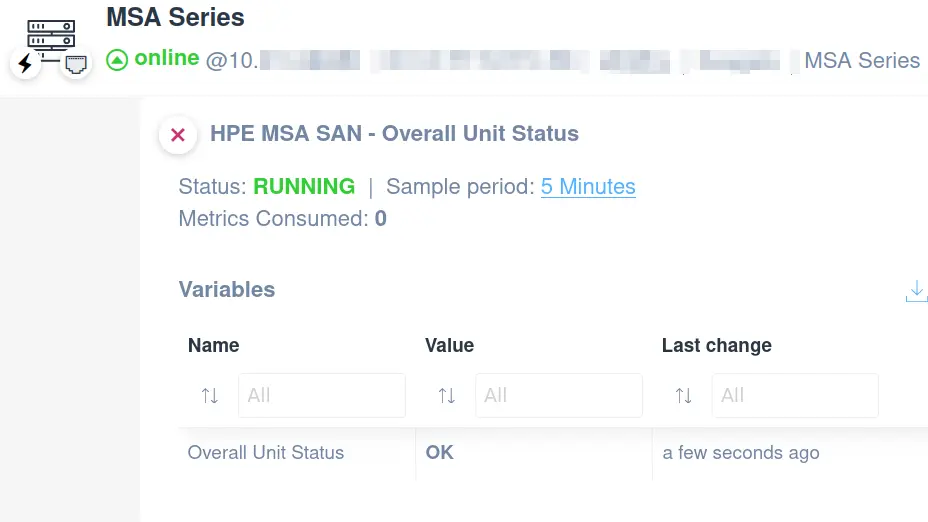
HPE MSA SAN Status Overview
1. The system shows the status of "HPE MSA SAN - Overall Unit Status" as "RUNNING" in green text.
2. The sample period is set to "5 Minutes."
3. Metrics consumed are "0."
4. Under "Variables," the table lists columns: "Name," "Value," and "Last change."
5. The row under these columns shows "Overall Unit Status" with a value of "OK" and a "Last change" recorded as a few seconds ago.
HW Sensors – Temperature and Charge
These two scripts are designed to provide detailed insights into:
- Sensor name (ID)
- Value
- Status
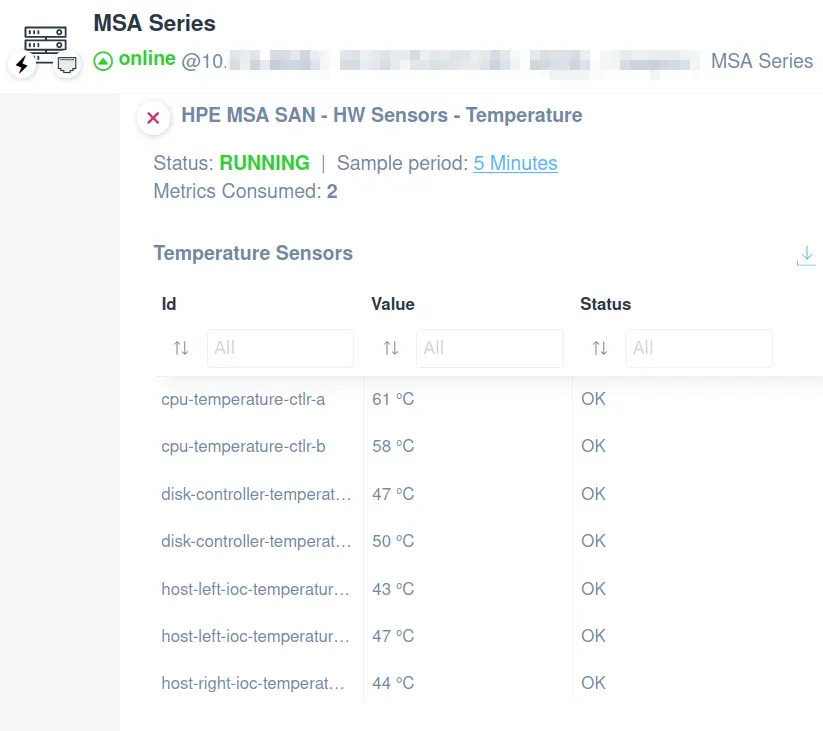
Monitoring Temperature Sensors on an MSA Series Device
1. The status of the MSA Series device is shown as "online" with a green indicator.
2. The HPE MSA SAN hardware sensors are monitoring temperature, with the system status labeled as "RUNNING."
3. The sample period for measuring metrics is every 5 minutes, and a total of 2 metrics are consumed.
4. The "Temperature Sensors" table displays three columns: Id, Value, and Status.
5. Each sensor Id corresponds to a particular component, such as "cpu-temperature-ctrlr-a."
6. The Value column shows the current temperature in degrees Celsius for each sensor.
7. The Status column indicates the operational status of each sensor with "OK."
8. All sensors listed report an "OK" status, suggesting normal functioning.
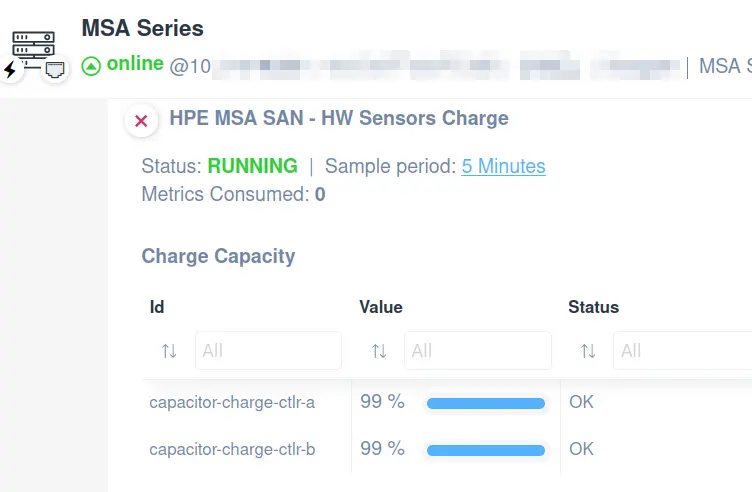
Monitoring Charge Capacity in HPE MSA SAN
1. The "MSA Series" section shows the system status as online.
2. The "HPE MSA SAN - HW Sensors Charge" indicates that the status is running, with a sample period of 5 minutes.
3. The "Charge Capacity" table lists sensor IDs, all showing a 99% charge value, and the status as OK, indicating normal operation.
HW Sensors – Voltage/Current
Applying this script, you will be able to monitor the following:
- Sensor name (ID)
- Voltage
- Current
- Status
The script has been validated and tested on HPE MSA 2050 SAN version VL270P005.
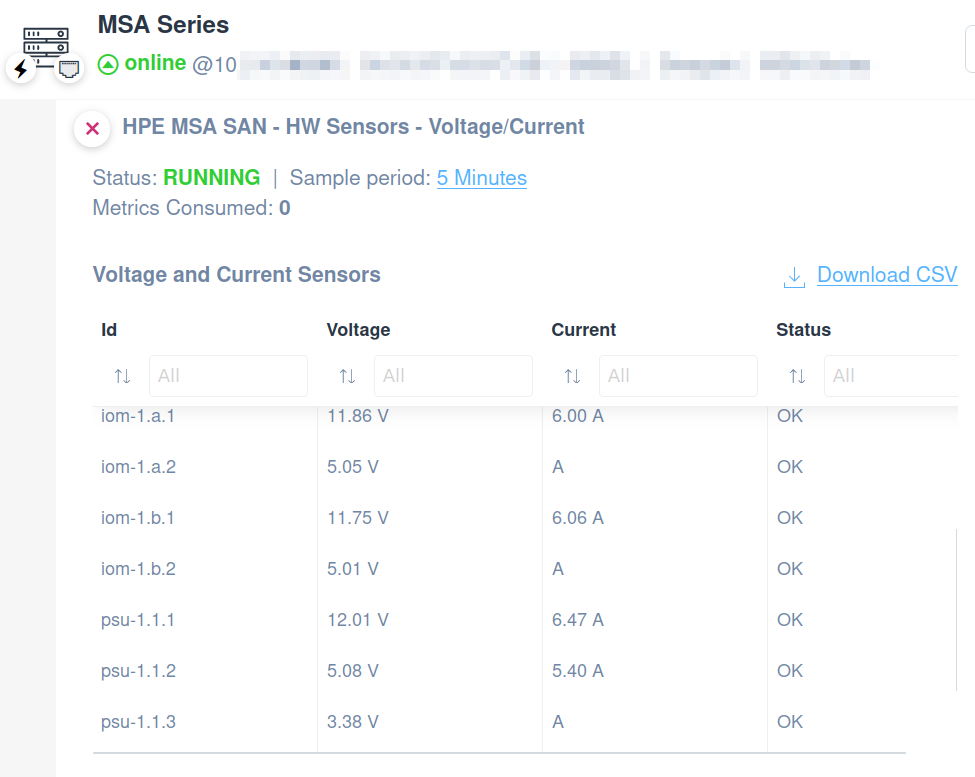
Monitoring Voltage and Current Sensors on HPE MSA SAN
1. The system status is displayed as "RUNNING," with a sample period of 5 minutes and metrics consumed showing zero.
2. The table titled "Voltage and Current Sensors" lists hardware sensor data.
3. Columns include Id, Voltage, Current, and Status. Examples from the table:
- Sensor "iom-1.a.1" shows a voltage of 11.86 V and a current of 6.00 A, with status "OK."
- Sensor "psu-1.1.3" shows a voltage of 3.38 V with status "OK."
4. A "Download CSV" option is available on the right for exporting the data.
Fans
This script is designed to allow you to monitor key aspects of fan operation, ensuring your system remains cool and functions optimally.
With this script, you can track:
- Fan name (ID)
- Health status
- Fan status
- Speed
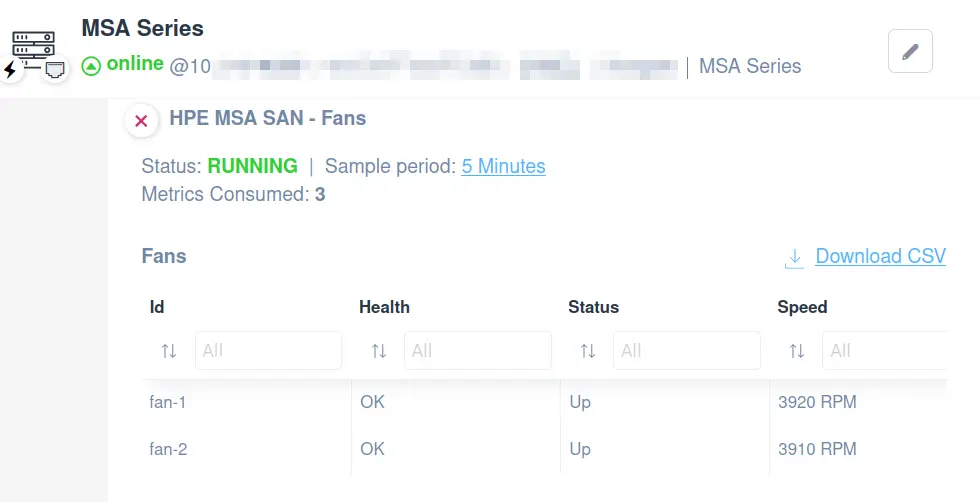
MSA Series Fans Monitoring Page
1. Locate the status section to check system status. It shows "RUNNING" indicating the system is operational.
2. The sample period is set to "5 Minutes," detailing the interval for data collection.
3. "Metrics Consumed" indicates 3 metrics have been collected.
4. A table labeled "Fans" displays information on individual fans:
- Columns include Id, Health, Status, and Speed.
- Fan-1 has "OK" health, "Up" status, and speed of "3920 RPM."
- Fan-2 also has "OK" health, "Up" status, and speed of "3910 RPM."
5. For records, use the "Download CSV" link to download fan data.
Controllers
Rely on our script to monitor the status of each controller in an HPE MSA SAN server. You’ll be able to monitor the following:
- Controller ID
- IP address
- Disks
- Controller status
- Health status
- Redundancy mode
- Redundancy status
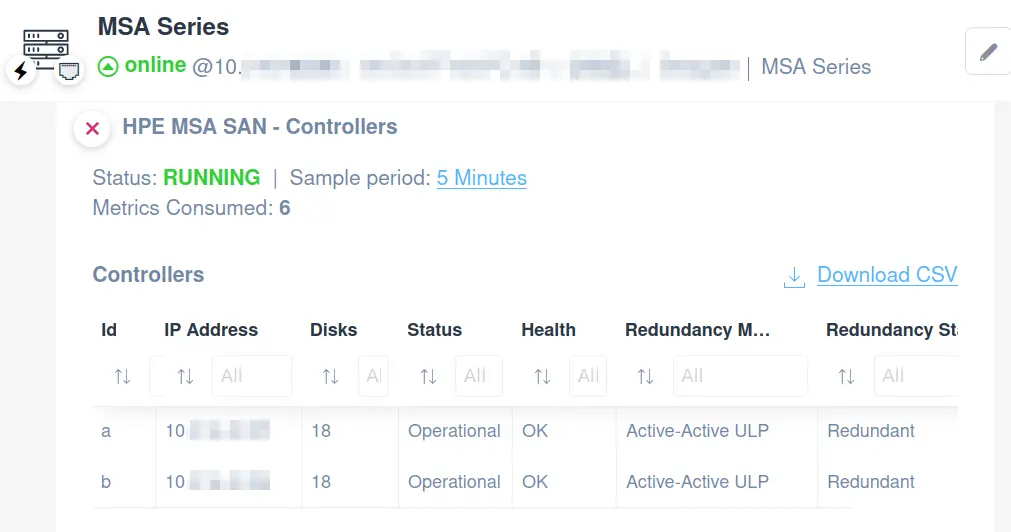
Controller Status Overview in HPE MSA SAN
1. The system status is shown as "RUNNING" in green. It indicates the sample period is every 5 minutes, with 6 metrics consumed.
2. The table under "Controllers" lists details for each controller including:
- Id: Identified as 'a' and 'b'.
- IP Address: Partially visible IP addresses for each controller.
- Disks: Each controller has 18 disks.
- Status: Both controllers are marked as "Operational".
- Health: Displays "OK" for both.
- Redundancy Mode: Both show "Active-Active ULP".
- Redundancy Status: Both are labeled as "Redundant".
3. Option to download the data as a CSV file is available through the "Download CSV" link.
Disks
Use our ready-to-use script to monitor the Disks on the following components:
- Disk location (ID)
- Serial number
- Usage
- Disk group
- Pool name
- Tier
- Status
- Health status
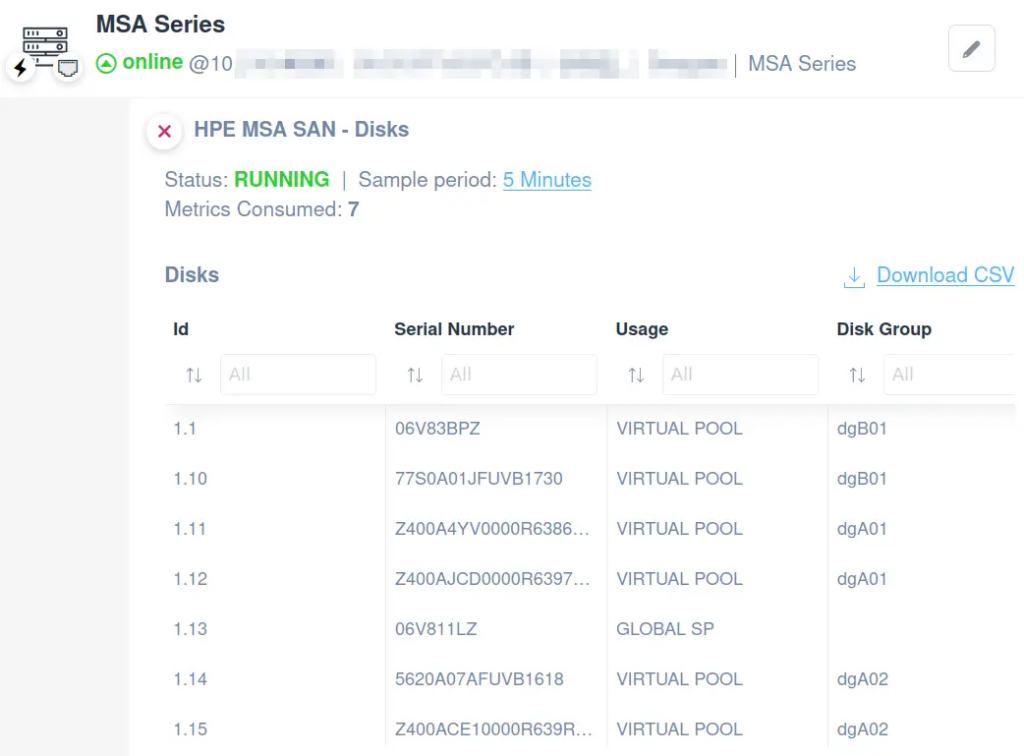
Overview of MSA Series Disk Status
1. The status section shows that the device is online and the HPE MSA SAN disks are running. The sample period is set to 5 minutes with 7 metrics consumed.
2. A table lists disks with four columns: Id, Serial Number, Usage, and Disk Group.
3. Each disk entry includes:
- Id: Unique identifier (e.g., 1.1, 1.10).
- Serial Number: Specific to each disk (e.g., 06V83BPZ).
- Usage: Indicates if the disk is part of a Virtual Pool or Global SP.
- Disk Group: Specifies disk group assignment (e.g., dgB01).
4. Options to filter each column are available, and there is a link to download the data as a CSV file.
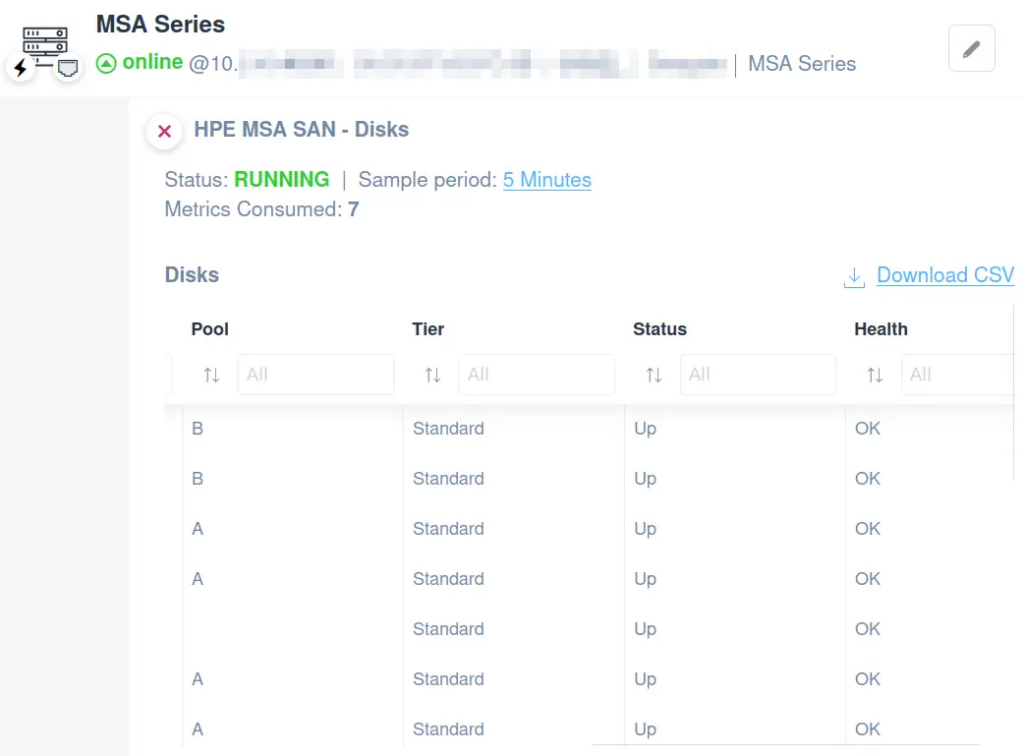
Viewing Disk Status in the HPE MSA SAN Interface
1. The interface shows the current status of the MSA Series device, indicating it is online.
2. Under the "HPE MSA SAN - Disks" section, it displays the system's status as "RUNNING" and mentions a sample period of five minutes.
3. Metrics Consumed are listed as 7.
4. A table titled "Disks" includes columns for Pool, Tier, Status, and Health.
5. Each row details specific disks, with Pool values as "B" or "A," Tier as "Standard," Status as "Up," and Health as "OK."
6. An option to "Download CSV" is available for exporting the data.
HPE iLO
Easily apply our integration scripts. Use them to monitor the following:
- System Information
- Fans
- Components Temperatures
- Power Supplies
- Memory Status
- System Status
Please note that these scripts use HTTP protocol and have been validated and tested on HPE iLO 5.
System General Monitoring
You can easily apply our General Monitoring script to monitor general information about your HPE iLO. Use it to create a variable section with the following:
- System type
- BIOS version
- Serial number
- System status
Easily monitor HPE iLO General information using the RedFish API.
Fans
This scripts retrieve detailed information about:
- Fan name (ID)
- Speed
- Fan status
Accessible in our library, this script stands as a crucial asset for maintaining the health and efficiency of your HPE iLO servers.
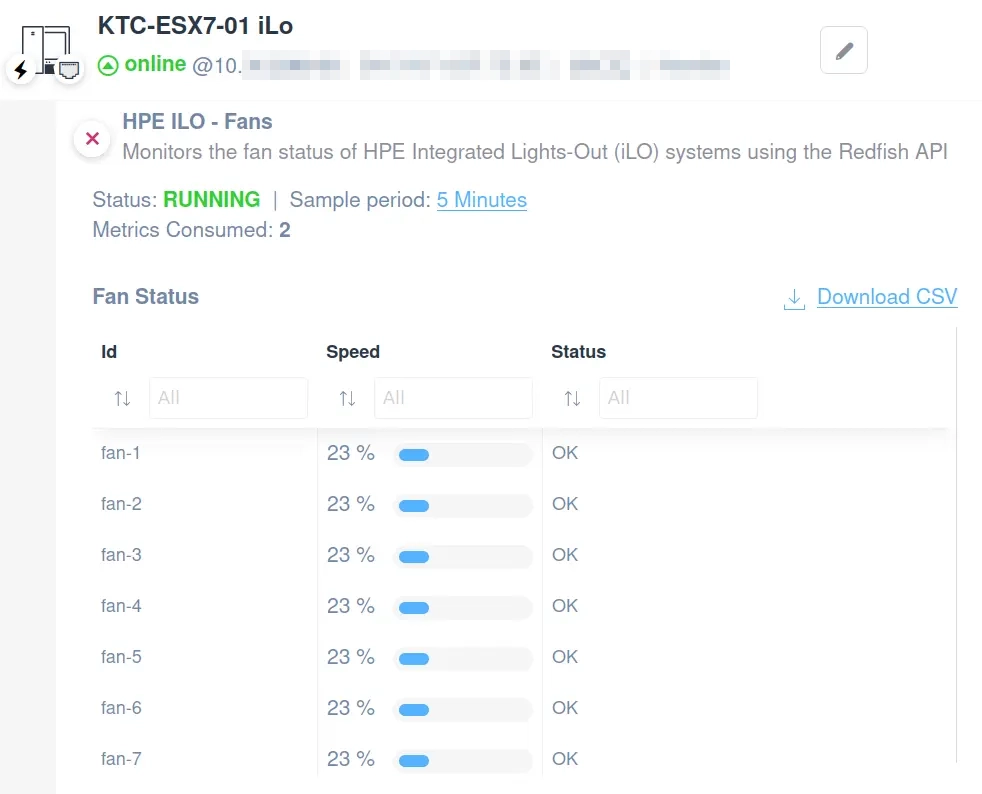
HPE iLO Fan Status Monitoring Dashboard.
1. The dashboard header shows "KTC-ESX7-01 iLo" with online status indicated in green.
2. The section labeled "HPE ILO - Fans" describes the monitoring of fan status using the Redfish API. The status is displayed as "RUNNING" in green, with a sample period of 5 minutes and metrics consumed as 2.
3. The "Fan Status" table lists fan details:
- Columns include Id, Speed, and Status.
- Each fan, labeled from fan-1 to fan-7, shows a speed of 23% and a status of "OK".
4. A "Download CSV" option is available for exporting the fan status data.
Components’ Temperatures
This script provides rapid access to critical temperature data, ensuring your hardware operates within safe thermal thresholds. Key features include monitoring of:
- Sensor name (ID)
- Temperature
- Status
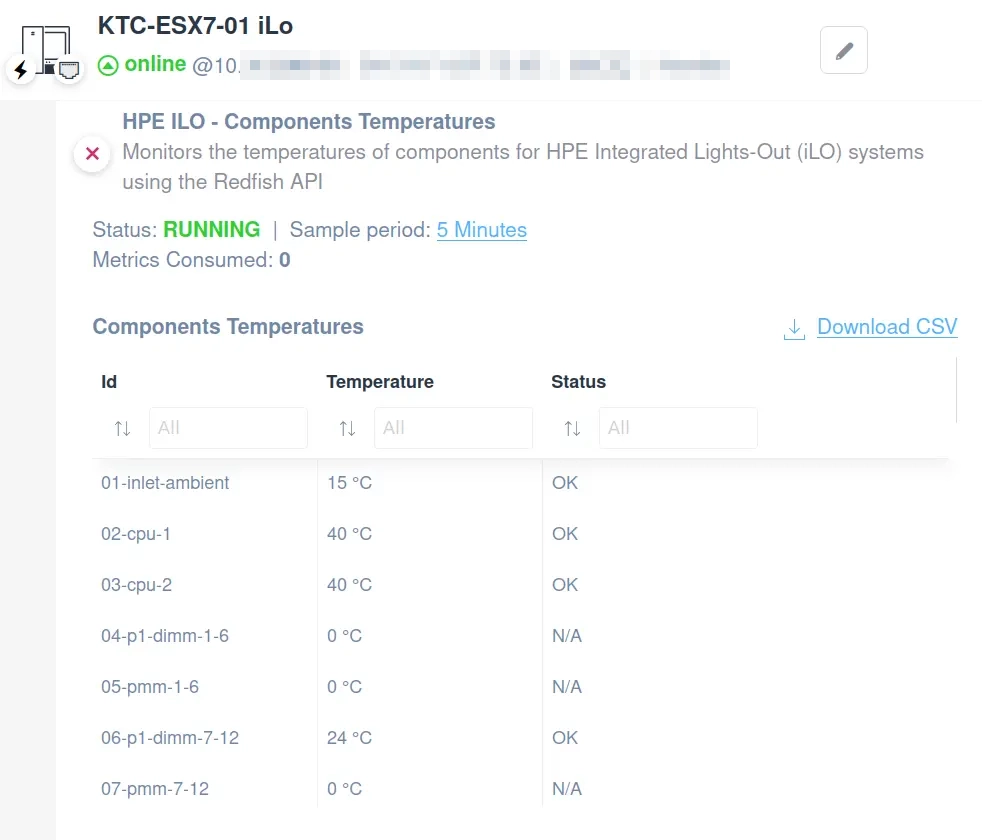
Monitoring HPE iLO Component Temperatures
1. The system labeled "KTC-ESX7-01 iLO" is currently online.
2. The interface shows the "Components Temperatures" for HPE Integrated Lights-Out (iLO) systems using the Redfish API.
3. Status indicates "RUNNING" with a sample period set to "5 Minutes" and "Metrics Consumed" showing "0."
4. A table displays component IDs, their corresponding temperatures, and status:
- "01-inlet-ambient" has a temperature of 15°C and status "OK."
- "02-cpu-1" and "03-cpu-2" both have a temperature of 40°C and status "OK."
- "04-p1-dimm-1-6," "05-pmm-1-6," and "07-pmm-7-12" all show 0°C with status "N/A."
- "06-p1-dimm-7-12" shows 24°C with status "OK."
5. There is an option to download the data as a CSV file.
Power Supplies
This script, which employs the HTTP protocol for seamless integration, provides real-time monitoring capabilities, enabling you to monitor as follows:
- PSU ID
- PSU status
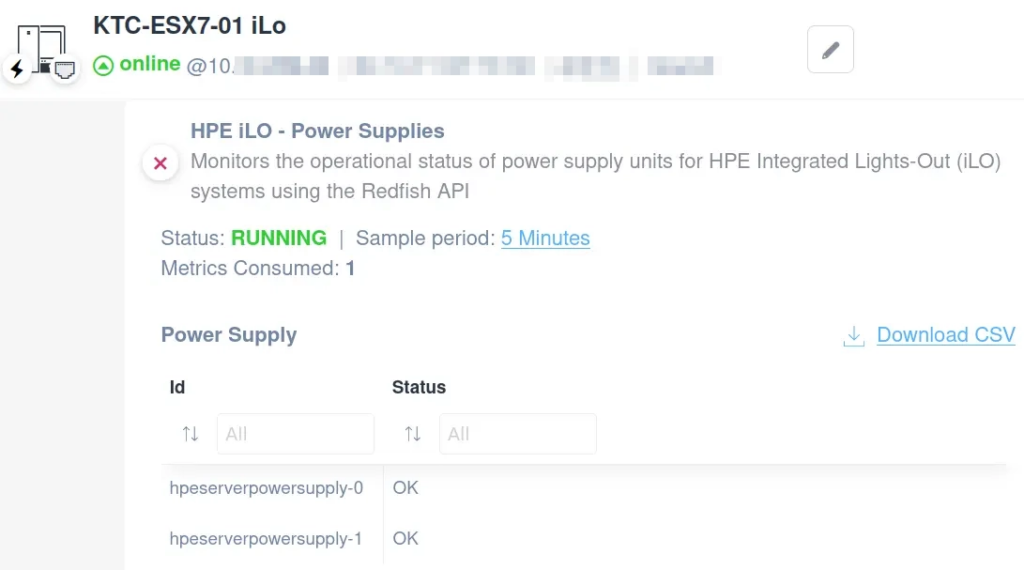
Monitoring Power Supply Status in HPE iLO
1. The interface title displays "KTC-ESX7-01 iLo" with an indication that the system is online.
2. The section labeled "HPE iLO - Power Supplies" describes monitoring the operational status of power supply units for HPE Integrated Lights-Out systems using the Redfish API.
3. The status is shown as "RUNNING," with a sample period linked to "5 Minutes," indicating the frequency of updates.
4. Metrics consumed count is displayed as "1."
5. The "Power Supply" table lists the power supplies with their IDs and statuses. The IDs are "hpeserverpowersupply-0" and "hpeserverpowersupply-1," both showing a status of "OK."
6. A "Download CSV" option is available for exporting the data.
Memory Status
This pre-designed script offers a straightforward approach to ensure your system’s memory is functioning correctly, enabling you to monitor:
- Memory slot ID
- Status
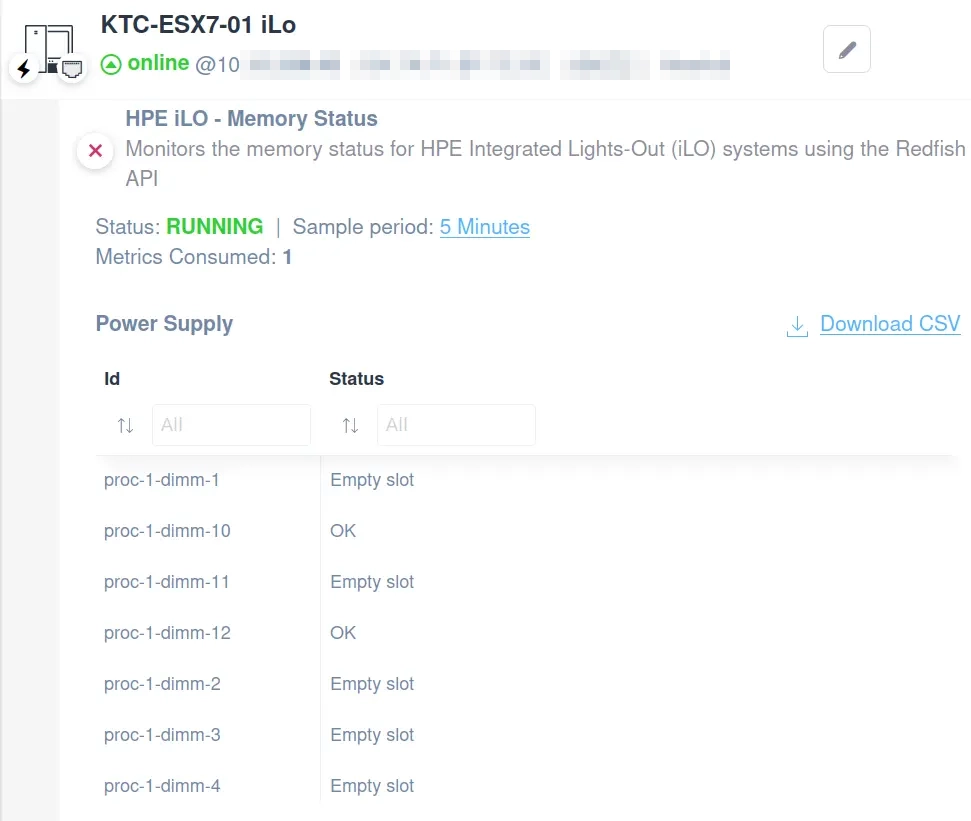
HPE iLO Memory Status Overview
1. The system, named "KTC-ESX7-01 iLo," is currently online, indicated by a green status.
2. The section titled "HPE iLO - Memory Status" monitors memory for HPE Integrated Lights-Out systems.
3. Current status is "RUNNING." The sample period is set to 5 minutes, with 1 metric consumed.
4. The "Power Supply" table lists memory slots:
- "proc-1-dimm-1" and "proc-1-dimm-3" show as "Empty slot."
- "proc-1-dimm-10" and "proc-1-dimm-12" show as "OK."
5. Option available to download the data as a CSV file.
System Status
Apply the HPE iLO System Status to improve your monitoring activities on the following valuable data:
- Component name (ID)
- System status
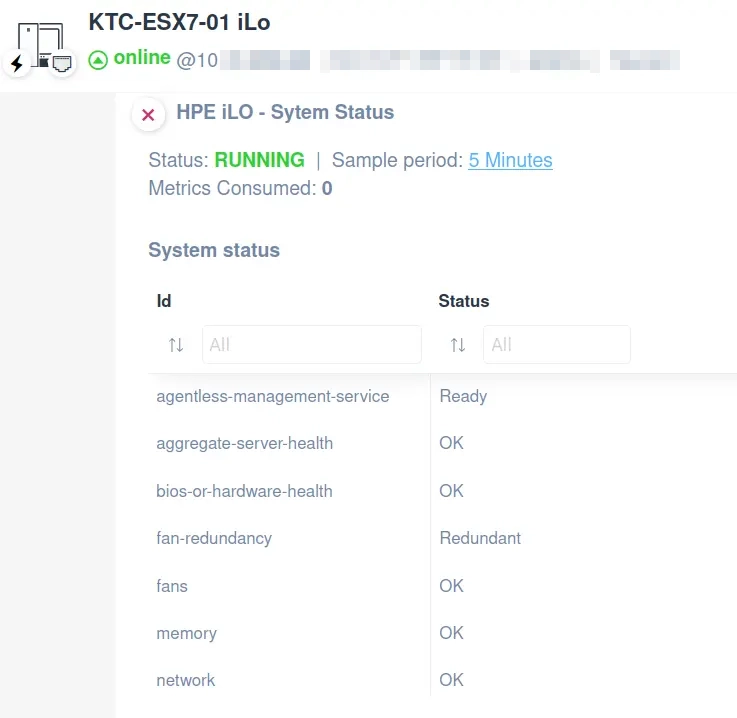
HPE iLO System Status Overview
1. The system is identified as "KTC-ESX7-01 iLO" and is currently online.
2. The status of the system is indicated as "RUNNING."
3. The sample period for the system metrics is set to "5 Minutes," and currently, "0" metrics have been consumed.
4. The "System status" section lists various components:
- "agentless-management-service" is marked as "Ready."
- "aggregate-server-health" is marked as "OK."
- "bios-or-hardware-health" is marked as "OK."
- "fan-redundancy" is marked as "Redundant."
- "fans," "memory," and "network" components are marked as "OK."
Dell PowerVault SAN
Effortlessly manage your Dell PowerVault Storage Area Network (SAN), a system optimized for cost-effective application acceleration perfectly suited for remote office setups.
Utilize our custom scripts to monitor your Dell PowerVault SAN hardware efficiently, covering:
- System General
- Drives
- Controllers Parameters
Using the HTTP protocol, these scripts are rigorously validated and tested on the Dell PowerVault ME502 model.
System General
With this script, you can effortlessly track:
- Serial number
- Health status
- Power state
Leverage the RedFish API to streamline the monitoring of general information on Dell PowerVault SAN systems.
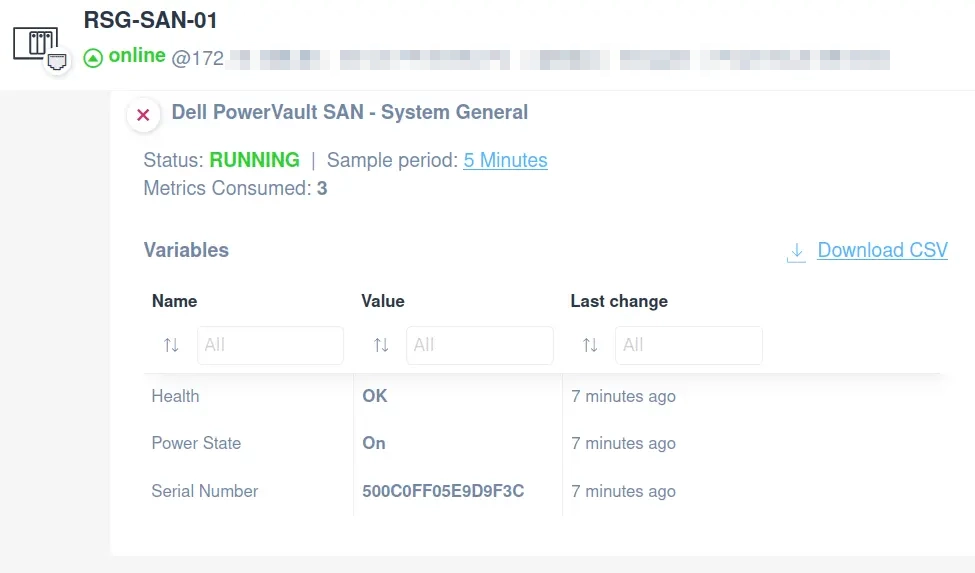
Status and Details of Dell PowerVault SAN System
1. The system identifier is "RSG-SAN-01", and it shows as "online" with a status indicator.
2. The status of the Dell PowerVault SAN is "RUNNING". The sample period is set to "5 Minutes", and the metrics consumed are "3".
3. A section labeled "Variables" lists three items: "Health" with a value of "OK", "Power State" with a value of "On", and "Serial Number" displaying "500C0FF05E9D9F3C". Each variable shows the last change occurring "7 minutes ago".
4. There is an option to "Download CSV" for further data analysis.
Drives
This integration script enables you to track drive status within the Dell PowerVault SAN system efficiently, covering crucial information such as:
- Drive ID
- Serial number
- Rack
- Rack offset
- Health
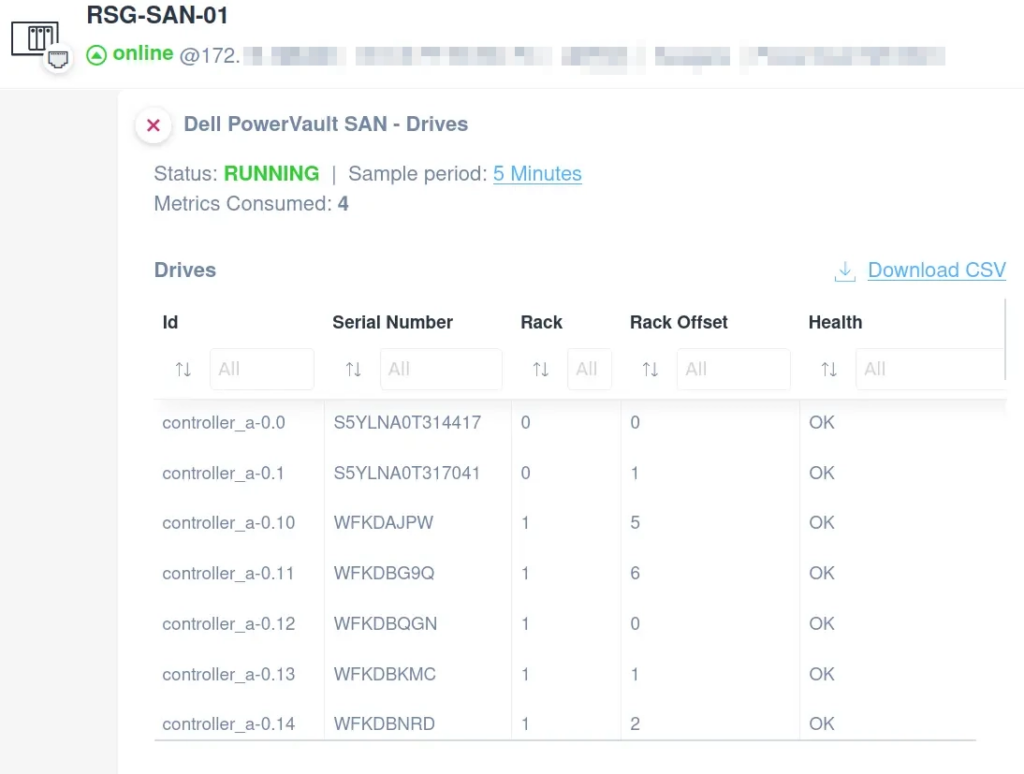
Dell PowerVault SAN Drive Status Overview
1. The system, labeled "RSG-SAN-01," is online with status information showing the IP address partially visible.
2. The Dell PowerVault SAN has a status of "RUNNING," with a sample period linked to "5 Minutes." Metrics consumed are noted as "4."
3. The "Drives" section displays a table with columns: Id, Serial Number, Rack, Rack Offset, and Health.
4. Each drive is listed by id, such as "controller_a-0.0" and "controller_a-0.1," along with their corresponding serial numbers, rack locations, and health status marked as "OK."
5. A "Download CSV" link is present for exporting the table data.
Controllers
This customized tool grants you the capability to oversee each controller’s status within a Dell PowerVault SAN setup, offering comprehensive insights into:
- Controller name (ID)
- Serial number
- Health status
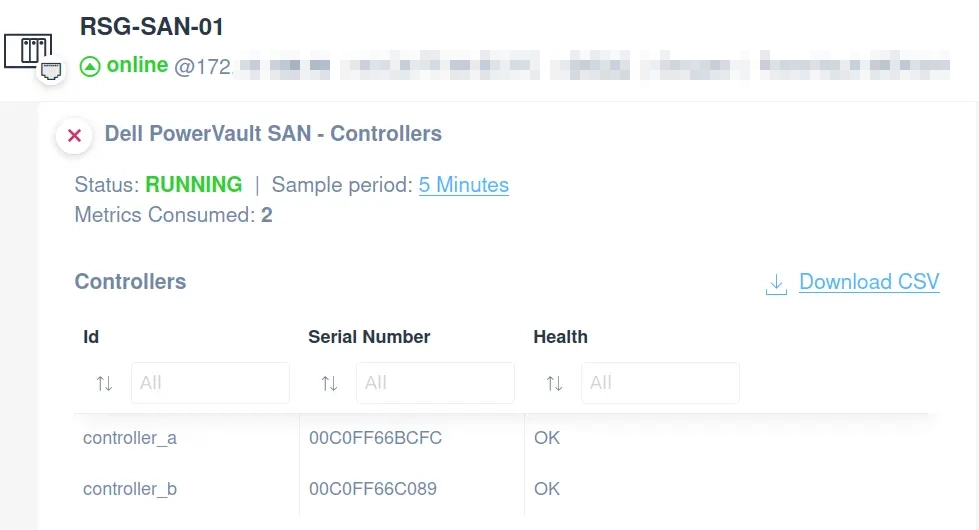
Monitoring Dell PowerVault SAN Controllers
1. The system title is "RSG-SAN-01," and it is currently online, indicated by a green status label.
2. The "Dell PowerVault SAN - Controllers" section shows the status as "RUNNING" with a sample period of 5 minutes, and metrics consumed is 2.
3. The "Controllers" section lists two controller IDs: "controller_a" and "controller_b," each with their respective serial numbers "00C0FF66BCFC" and "00C0FF66C089."
4. The health status for both controllers is labeled as "OK."
5. There is an option to download the table information as a CSV file.
MikroTik
Easily apply the MikroTik script in order to monitor DHCP address pools. You’ll be able to monitor the following:
- Pool name (Id)
- Start IP Address
- End IP Address
- Number of used IP addresses
- Number of free IP addresses
- Number of total IP addresses
The script uses SSH protocol and has been validated and tested on the following MikroTik routers: RB5009UG+S+.
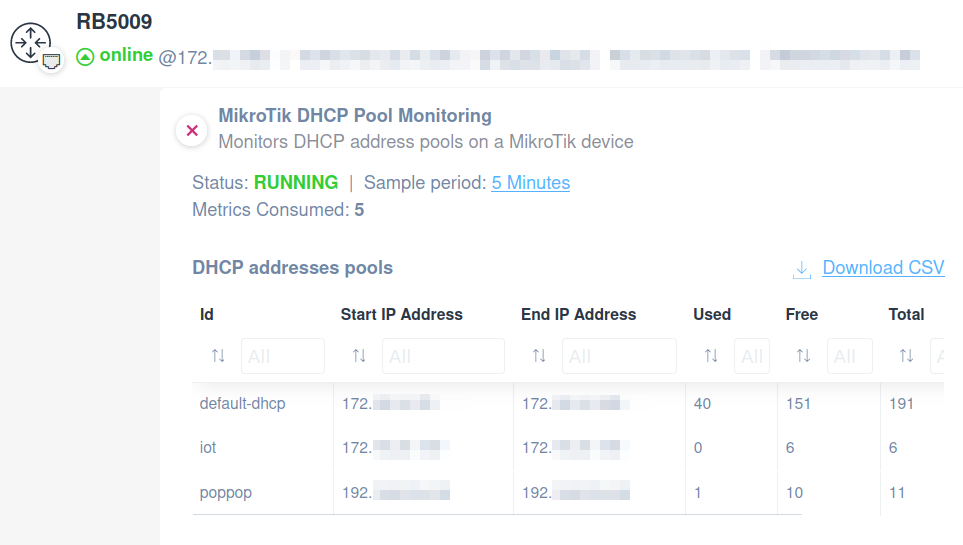
Monitoring DHCP Address Pools on a MikroTik Device
1. The device is labeled as "RB5009" and shows an online status with an associated IP address.
2. The "MikroTik DHCP Pool Monitoring" section indicates that DHCP address pools are being monitored. The status is "RUNNING," the sample period is every 5 minutes, and 5 metrics have been consumed.
3. The "DHCP addresses pools" table lists three pool IDs: "default-dhcp," "iot," and "poppop." Each entry includes start and end IP addresses, and the number of addresses used, free, and total.
4. A "Download CSV" option is available to export the data.
Improvements
Configuration Management Enhancements
We’re excited to announce several improvements to our Configuration Management feature, designed to enhance usability and reliability:
- Automatic Integration Pause: To maintain operational efficiency, Configuration Management will now pause after five consecutive backup failures, with an alert sent to the account owner. You can manually reactivate Configuration Management from the device’s details tab.
- Access to Backups on Locked Devices: You can now access Configuration backups even when devices are locked due to authentication errors, ensuring vital data remains reachable. Please note that the re-authentication is required to restart automatic backups.
- Difference View Enhancement: The Configuration Management feature has been upgraded for better performance with large files, making it easier to spot differences and changes over time.
- Helpful Unlocking Instructions: New users unlocking a device for Configuration Management will find a helpful link directing them to a guide with detailed configuration instructions, streamlining the setup process.
These updates are part of our commitment to continually improve the Domotz experience, making network management more intuitive and effective.
Custom Drivers/Integration Scripts
Significant improvements were also made to our Custom Drivers/Integration Scripts aimed at enhancing stability and expanding functionality:
Optimized Parallelism: To ensure the reliability of our Network Collector, we introduce a cap on the parallel execution of Scripts. This measure is designed to prevent potential crashes by efficiently managing the system’s resource usage.
Enhanced Script Capabilities: Scripts can utilize discovered device MAC addresses and serial numbers, allowing for more robust device identification methods beyond IP addresses. This enhancement enables you to tailor your integration scripts more precisely to your networking environment.
Improved Connectivity Issue Resolution
In our latest update, we’ve improved the message that our WebApp and Mobile App show in relation to connectivity issues.
When Domotz detects that a firewall is blocking outgoing connections to the Domotz Cloud, you will be presented with a clearer, more informative message.
This message will guide you to a dedicated help page, offering a step-by-step guide on adjusting your firewall settings to resolve the issue.
Streamlined Device Detail Access
We’ve made an important improvement to your experience within the Domotz platform. Recognizing the need for a smoother interaction, we have removed the unlock popup that previously appeared upon the first visit to a device’s detail page.
This change means you will no longer receive an immediate suggestion to unlock the device for credential input during your initial inspection. This update is designed to enhance navigation efficiency within the Domotz platform, allowing you to explore device details more seamlessly and without interruption, thereby improving the overall user experience.
Add support for Configuration Management on Aruba CX Switch OS
This enhancement signifies our commitment to expanding compatibility and ensuring seamless network management experiences.
Specifically, the new Aruba CX Switch OSl now supports Configuration Management, marking a significant step forward in our efforts to provide comprehensive control and flexibility for network administrators.
Additional MIBs available in the Domotz Database
Additional MIB files are available for the following devices.
- ARDF cell devices
- Aruba instant MIB
- Zyxel GS1900 series
- Riedel Artist
- HP LaserJet
- DHCP MIB
Fix
- Display the correct number of Important Offline devices when there are devices with grouped interfaces
- Display appropriate Metrics consumption for devices
- Configuration Management issues with Aruba and Netgear devices
- Configuration Management: Incorrect state of config inspection
- You could not connect to the new UniFi Controller when there was an old one previously deleted
- Latest Configuration Backup older than one year is not accessible
- Configuration Backup: the “unlock” should not appear in the access management of Aruba
- HP Aruba AP Configuration changes alerted every six hours
- Account Management, “Agent Cleanup”, option not deleting expected information
- DHCP Requests Rate not showing
- DHCP Requests Rate wrong device sort
- Wrong date format inside the Logging & Reports page
- Logging & Reports page has missing icons for Agents Alerts change
- Cannot create a Domotz Agent on a machine already having a GlassWire Endpoint
- Wrong color on the input field
- Ubiquiti Edge Switch authentication status reset incorrectly
- Rectified the Metrics calculation for devices with SNMP Pre-Configured Templates. Incorrect numbers were displayed on the Device detail and Metrics management view.
- Visualization of long script parameters description was breaking the UI
- Netgear switch missing Interfaces tab
- Remote connection issues
- The number of devices supporting a sensor is inconsistent
- Network troubleshooting dashboard showing inconsistent IP-Conflict data
- Cannot sync ITGlue to Domotz due to missing location
- Fake Synology devices discovered, causing hundreds of important offline devices